Introduction: election forensics begins before election night
When election integrity is discussed, public attention usually focuses on election day and election night: whether polling stations opened on time, whether polling-station records were completed correctly, whether votes were counted accurately, and whether official results match independent estimates. These are essential questions. Without accurate counting, there can be no serious electoral integrity.
But democratic integrity does not begin at 7 a.m. on election day, and it does not end with the tabulation of polling-station records. Elections are also shaped by the political environment in which voters form their preferences. If, for months before an election, one side is described as “statesmanlike,” “protective,” “successful” and “victorious,” while its opponents are repeatedly labelled “traitors,” “mercenaries,” “terrorists,” “fascists” or “scum,” then the electoral race does not begin from an equal starting line.
This is why media language matters for election forensics in the broader sense. Election forensics should not be reduced to post-election statistics alone. It also needs to examine the conditions under which electoral preferences were formed: media access, campaign fairness, misuse of public resources, voter pressure, delegitimising rhetoric and institutional response. Word clouds do not prove electoral fraud. They do, however, help visualise the language environment in which political competition takes place.
In that sense, words are not just words. Repetition matters. Labels matter. The emotional architecture of public communication matters. It can normalise one political actor while delegitimising another. It can frame political competition as a democratic contest, or as a struggle between a national protector and enemies of the state.
What is a word cloud and how should it be read?
A word cloud is a simple visual representation of word frequency in a selected body of text. The larger the word, the more frequently it appears in the analysed material. In this case, the word clouds are based on the top recurring words and phrases used in Serbian pro-government and tabloid media to describe two political subjects: the opposition and President Aleksandar Vučić.
A word cloud should be read carefully. It does not show the full context of every word. It does not automatically distinguish between quotation, headline, editorial framing or commentary. It cannot replace systematic media monitoring, sentiment analysis, discourse analysis or legal assessment. But it is useful as a first visual signal. It shows the dominant vocabulary, the emotional tone and the symbolic frame attached to political actors.
For election forensics, such a tool can serve as an entry point into the political environment of elections. If one side is repeatedly associated with betrayal, violence, foreign influence and criminality, while another is associated with strength, protection, success and national leadership, this is not a neutral communicative space. It suggests an asymmetry that should be examined as part of broader electoral integrity analysis.
The goal is not to police political criticism. Democratic politics allows sharp criticism, satire, argument and disagreement. The issue is systematic framing: repeated language that transforms political opponents from legitimate competitors into enemies, threats or objects of social contempt.
The opposition in a word cloud: from political competitor to enemy
The word cloud describing the opposition is dominated by hostile and delegitimising language. Many of the terms do not simply criticise the opposition’s programme, decisions or political behaviour. They place opposition actors in a moral and security frame: betrayal, violence, criminality, foreign control and hostility toward the state.
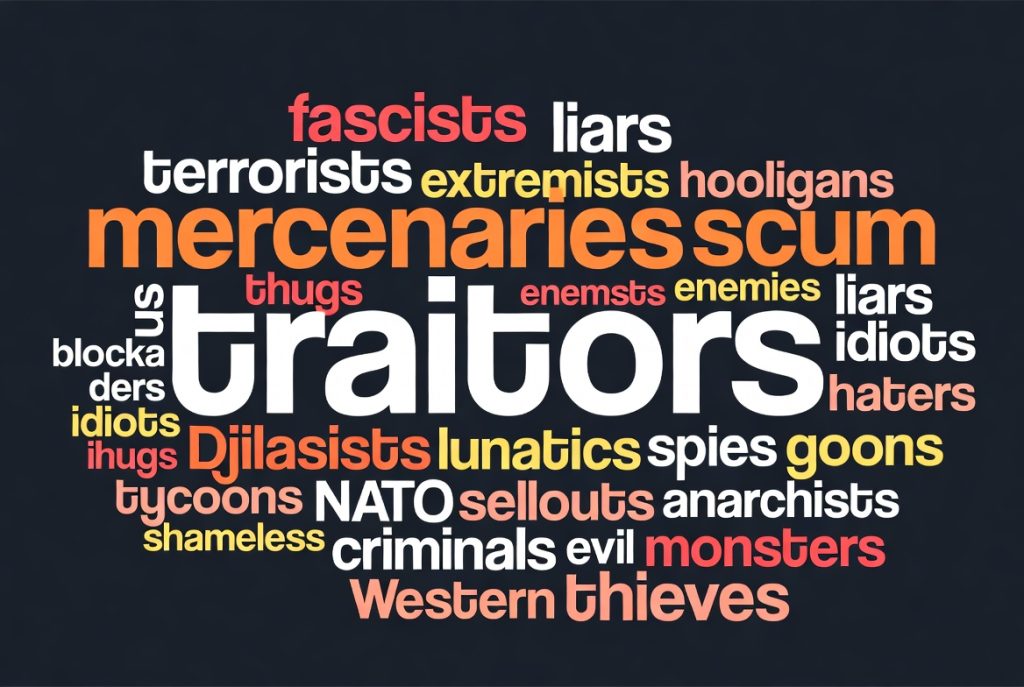
Note: Larger words indicate higher relative frequency in the analysed media discourse. The cloud visualises recurring labels used in pro-government and tabloid media to describe the opposition, protesters, students and critics of the government.
Table 1: Top 30 words and phrases used to construct the opposition word cloud
Note: The table should include rank, Serbian term or phrase, and English translation/context.
| Rank | Serbian | English | Context |
|---|---|---|---|
| 1 | izdajnici | traitors | Used to discredit opposition figures as betraying the nation, rather than as legitimate political competitors. |
| 2 | plaćenici / strani plaćenici | mercenaries / foreign mercenaries | Frames the opposition or protesters as externally funded actors serving foreign interests rather than citizens. |
| 3 | teroristi | terrorists | Applied to protesters, students and the opposition to securitise dissent and equate protest with a violent threat. |
| 4 | fašisti | fascists | Used as a moral-historical label to fully delegitimise opponents and place them outside democratic debate. |
| 5 | ekstremisti | extremists | Portrays the opposition as radical and dangerous, outside the boundaries of normal democratic politics. |
| 6 | huligani | hooligans | Associates protests and opposition rallies with street disorder and violence rather than political expression. |
| 7 | nasilnici | thugs / violent people | Frames critics as inherently violent and shifts attention from their demands to the alleged character of participants. |
| 8 | kriminalci | criminals | Criminalises the opposition or its leaders by presenting political competition as a matter of crime. |
| 9 | ološi | scum | A dehumanising insult that portrays opponents as morally worthless and unfit for public life. |
| 10 | bitange | rascals / thugs | A pejorative for crude or disreputable people, used to belittle political opponents. |
| 11 | lopovi | thieves | Frames opposition actors as corrupt and dishonest, attacking their moral credibility. |
| 12 | lažovi | liars | Used to pre-emptively frame opposition claims, criticism and evidence as false or manipulative. |
| 13 | neprijatelji | enemies | Frames political opponents as threats to the state or nation rather than democratic competitors. |
| 14 | idioti / opasni idioti | idiots | Belittles opponents’ intelligence and rationality, replacing debate about arguments with insult. |
| 15 | monstrumi | monsters | Dehumanises opponents and intensifies emotional fear or contempt toward them. |
| 16 | blokaderi | blockaders | Used for participants in blockades and protests, shifting attention from political demands to disruption of public order. |
| 17 | špijuni | spies | Suggests secret cooperation with foreign actors and links the opposition with betrayal of national interests. |
| 18 | mrzitelji | haters of Serbia | Frames critics as people who hate Serbia, monopolising patriotism within the pro-government narrative. |
| 19 | rasisti | racists | An accusation that morally discredits opponents and shifts debate from policy to their alleged character. |
| 20 | đilasovci | Đilas followers | Reduces diverse opposition actors to followers of one leader, enabling personalised discrediting. |
| 21 | tajkuni | tycoons | Links the opposition with wealthy interest groups and corruption, suggesting it is not genuinely popular. |
| 22 | batinaši | club-wielders / goons | Labels opposition or protest actors as violent enforcers, especially in the context of street confrontations. |
| 23 | ludaci | lunatics | Pathologises political disagreement by portraying critics as irrational, unstable or dangerous. |
| 24 | NATO | NATO-opozicija / NATO plaćenici | Used as a geopolitical label linking the opposition to NATO and foreign pressure. |
| 25 | zapadni | Western / Western-backed | Suggests that opposition politics or protests are controlled, supported or shaped by the West. |
| 26 | anarhisti | anarchists | Frames the opposition or protests as a threat to order and stability rather than democratic criticism. |
| 27 | globalisti | globalists | Links opponents with transnational elites and interests, suggesting detachment from domestic citizens. |
| 28 | prodani | sellouts | Labels political opponents as bought, compromised or loyal to someone else’s interests. |
| 29 | besramni / sramota | shameless / shame | A moral condemnation implying opponents lack shame, responsibility and legitimacy. |
| 30 | zlo | evil | An extreme moralising label that frames the opponent as evil itself rather than as a political actor. |
This distinction is crucial. In democratic politics, governments and oppositions criticise each other strongly. That is normal. What is different here is the repeated use of labels such as “traitors,” “terrorists,” “foreign mercenaries,” “spies,” “fascists” and “enemies.” Such language does not present the opposition as a legitimate alternative government or as a set of competing political programmes. It presents it as a danger.
This has direct relevance for electoral integrity. First, it may discourage citizens from openly supporting opposition actors. Second, it may stigmatise civic participation, including protests, observation and public criticism. Third, it may shape how institutions react , or fail to react, when opposition parties or civil-society organisations raise concerns. Fourth, it may delegitimise demands for verification of election results before those demands are even heard.
From the perspective of election forensics, this is a political signal. It does not prove that election-day procedures were manipulated. But it indicates that the pre-election environment may be systematically unequal. If a political actor is repeatedly placed outside the boundaries of legitimate politics, then the formal right to compete remains, but the practical ability to compete on equal terms is weakened.
This is where media analysis becomes part of the wider forensic picture. Ballot-box integrity matters. Polling-station records matter. Open election data matter. But the media environment also matters, because voters do not make choices in a vacuum. They make choices inside an information system.
Vučić in a word cloud: the personalised image of protector and winner
The second word cloud shows the opposite pattern. The vocabulary used to describe President Vučić is affirmative, personalised and protective. Terms such as “leader,” “protector,” “winner,” “successful,” “statesman,” “visionary,” “guardian,” “hero,” “invincible” and “father” build a political image centred on strength, stability and personal authority.
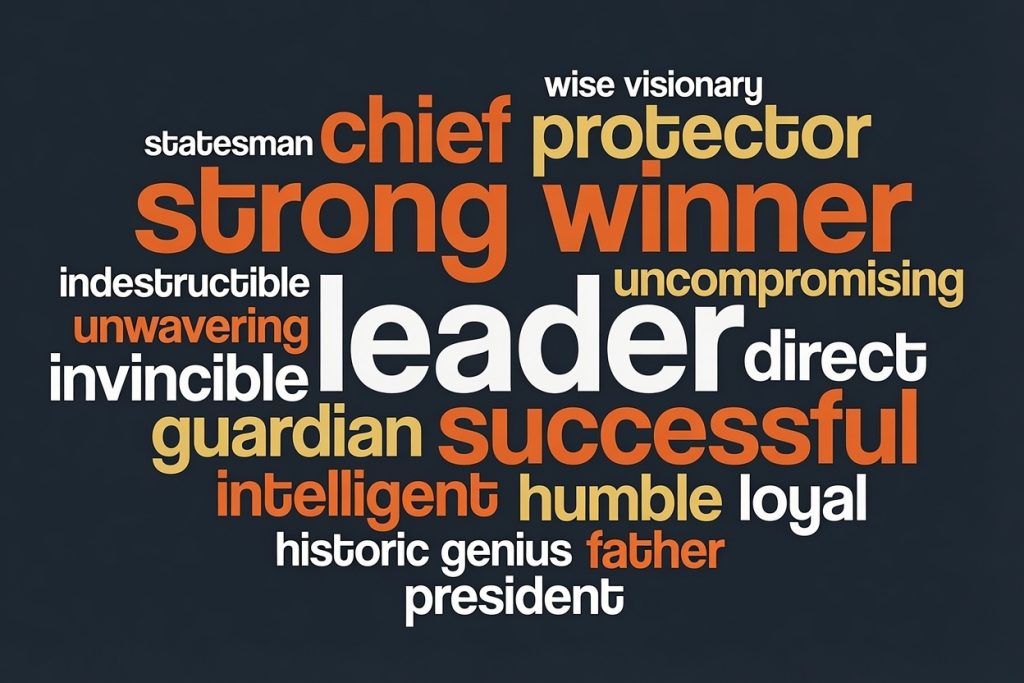
Note: The cloud visualises recurring positive and affirming labels used in pro-government media to describe the President of Serbia. Larger words indicate higher relative frequency in the analysed discourse.
Table 2: Top 30 words and phrases used to construct the Vučić word cloud
Note: The table should include rank, Serbian term or phrase, and English translation/context.
| Rank | Serbian | English | Context | |
|---|---|---|---|---|
| 1 | lider / veliki lider | leader / great leader | Used to present Vučić as the central figure of the political system and the main holder of political authority. | |
| 2 | vođa / neprikosnoveni vođa | leader / undisputed leader) | Used to emphasise unquestioned personal control and a leadership role above ordinary party politics. | |
| 3 | zaštitnik (zaštitnik Srbije / naroda) | protector (protector of Serbia) | Frames Vučić as the protector of Serbia, the people, and stability against external or internal threats. | |
| 4 | snažan | strong | Emphasises strength, resolve, and the ability to withstand pressure in political crises. | |
| 5 | pobednik | winner | Used to create an image of constant political victory and inevitable success in elections and negotiations. | |
| 6 | uspešan | successful | Presents government results as evidence of personal effectiveness, managerial ability, and political competence. | |
| 7 | patriot | patriot | Used to associate Vučić with the national interest and loyalty to the state and the people. | |
| 8 | mudri | wise | Emphasises wisdom, tactical skill, and the ability to make the right decisions in complex circumstances. | |
| 9 | hrabri | brave | Frames Vučić as a politician who does not retreat under pressure, risk, or opposition. | |
| 10 | vizionar | visionary | Used to present a long-term national plan and the ability to see beyond day-to-day politics. | |
| 11 | državnik | statesman | Presents Vučić as a responsible statesman standing above party interests. | |
| 12 | odlučan/ nepokolebljiv | determined / adamant | Emphasises firmness, persistence, and readiness to implement decisions despite resistance. | |
| 13 | neuništivi | indestructible | Used to construct an image of political resilience and an inability to be defeated or removed by pressure. | |
| 14 | nepobedivi | invincible | Presents Vučić as an actor who always wins and whose political dominance is expected in advance. | |
| 15 | čuvar (čuvar Srbije) | guard (guard of Serbia) | Frames Vučić as the guardian of the state, the people, peace, stability, or the national interest. | |
| 16 | reformator | reformer | Used to associate Vučić with modernisation, change, and economic or institutional progress. | |
| 17 | heroj | hero | Presents him as an exceptional figure who sacrifices for the state or achieves extraordinary political results. | |
| 18 | najbolji | the best | Used for maximal positive evaluation and to suggest that there is no better political alternative. | |
| 19 | posvećen | dedicated | Emphasises dedication to work, the state, and citizens, often within a narrative of constant effort. | |
| 20 | radnik (radi non-stop) | employee (works around the clock) | Used to portray continuous work, personal sacrifice, and availability in every crisis. | |
| 21 | jak | strong | Emphasises physical and political strength, especially in contrast to opponents or external pressures. | |
| 22 | inteligentan | intelligent | Frames Vučić as rational, capable, and superior in understanding problems and negotiations. | |
| 23 | skroman | humble | Used to soften the image of power and present the leader as close to ordinary citizens. | |
| 24 | verni | faithful | Emphasises loyalty to the state, the people, allies, or his own political promises. | |
| 25 | beskompromisni | uncompromising | Presents him as a leader who does not abandon key positions or make unprincipled concessions. | |
| 26 | istorijski | historical | Used to present Vučić’s decisions and role as historically significant for the state. | |
| 27 | genijalni | genius | Strengthens the image of exceptional ability, intelligence, and political superiority. | |
| 28 | otac (u kontekstu nacije) | father (in the context of the nation) | Used in a paternalistic frame that portrays Vučić as a protective father-like figure of the nation. | |
| 29 | neprikosnoveni | inviolable | Emphasises a status beyond challenge, criticism, or ordinary political replaceability. | |
| 30 | predsednik (sa snažnim pozitivnim okvirom) | president (with strong positive framing) | Used as a formal office title, but with a strong positive frame of authority, continuity, and legitimacy. |
Positive coverage of a political leader is not, in itself, a problem. Media outlets may support a government, criticise an opposition, endorse policies or highlight achievements. The democratic issue arises when a high-reach media ecosystem systematically combines strong positive personalisation of one actor with systematic demonisation of his opponents. In that case, the public sphere no longer functions primarily as a space for comparison of programmes and evidence. It becomes a moral hierarchy: protector versus enemies, order versus chaos, patriotism versus betrayal.
This matters before an election because voters are exposed not only to policy information, but also to emotional framing. Political communication shapes expectations, fears and perceived legitimacy. If one actor is repeatedly presented as the only guarantor of stability, and others as dangerous, foreign-controlled or anti-state, then the electoral terrain is shaped long before ballots are printed.
For election forensics, this means that post-election results should not be interpreted in isolation. Turnout, vote shares, regional patterns and changes across electoral cycles should be read alongside information about the campaign environment, media asymmetry, use of public office, pressure on voters and institutional responsiveness.
In a narrow sense, election forensics asks whether the numbers look unusual. In a broader sense, it also asks whether the political conditions that produced those numbers were sufficiently fair, open and pluralistic.
Conclusion: accurate counting is necessary, but not sufficient
The word clouds over Serbia show two sharply different media realities. In one, the opposition is frequently associated with betrayal, criminality, violence, foreign influence and hostility to the state. In the other, the President is associated with strength, victory, protection, wisdom and national leadership. This asymmetry is not only a matter of tone. It is part of the electoral terrain.
Accurate vote counting is necessary. But it is not sufficient. If one side in a political race receives daily reinforcement as the protector of the nation, while the other is repeatedly described as a threat to the nation, then the race does not begin on equal terms. Precise timing at the finish line does not make a race fair if one runner started one hundred metres ahead.
This is why election forensics must include the political environment, not only election-night arithmetic. It should connect official results with what happened before voting: media framing, incumbency campaigning, use of public resources, voter pressure, delegitimisation of opponents and institutional action or inaction.
The point is not to claim in advance that an election result is invalid. The point is to ask a more precise question: were the results produced under conditions in which citizens could choose freely, fairly and with access to balanced information?
That is the question of democratic integrity. Without it, an election result may be counted correctly, but still emerge from an uneven political field.
Appendix: Examples of pro-government media terminology (Campaign 1938)
Any resemblance to pro-government media terminology (Campaign 2026) is coincidental.
- How they described the opposition (the United Opposition of Vlatko Maček and the United Serbian Opposition): The regime newspaper Vreme called them “destructive elements”, “pact without principles”, “anti-state coalition” and “agents of Moscow and communism”. The campaign reduced the opposition to the concept of “disorder and chaos” that leads to the collapse of the state.
- How they described the ruling party (JRZ): Through the state media, the ruling regime called itself “guardians of national and national unity”, “guarantors of social peace and economic well-being”, while Milan Stojadinović was celebrated under the slogan “Leader” (terminology taken from authoritarian European models at the time). The main slogan of the pro-government press was that JRZ brings “order, work and peace”.

Director of Wellington based My Statistical Consultant Ltd company. Retired Associate Professor in Statistics.
Has a PhD in Statistics and over 45 years experience as a university professor, consultant, international researcher and government advisor.