Europe’s democratic landscape in 2025 cannot be divided neatly into countries that are democratic and countries that are not. The revised dataset instead reveals several distinct patterns: established democracies that have lost part of their previous strength, countries that have improved modestly from relatively weak starting positions, and a smaller group whose decline has fundamentally changed their place on the European democratic map.
The updated analysis covers 37 European countries and now includes Belarus and Russia. According to the supplied V-Dem data, the average Electoral Democracy Index (EDI) declined from 0.771 in 2001 to 0.710 in 2025. The average change was –0.062, while the median change was –0.030. Twenty-seven countries recorded lower values in 2025, nine improved and Luxembourg remained unchanged.
These figures point to broad democratic erosion, but not to a uniform European collapse. Most countries still retain comparatively high EDI values. The deterioration is concentrated unevenly, and several major negative cases, particularly Hungary, Serbia and Russia—substantially influence the continental picture.
The red line answers the most important question
The scatterplot is much easier to interpret because it contains two different reference lines.
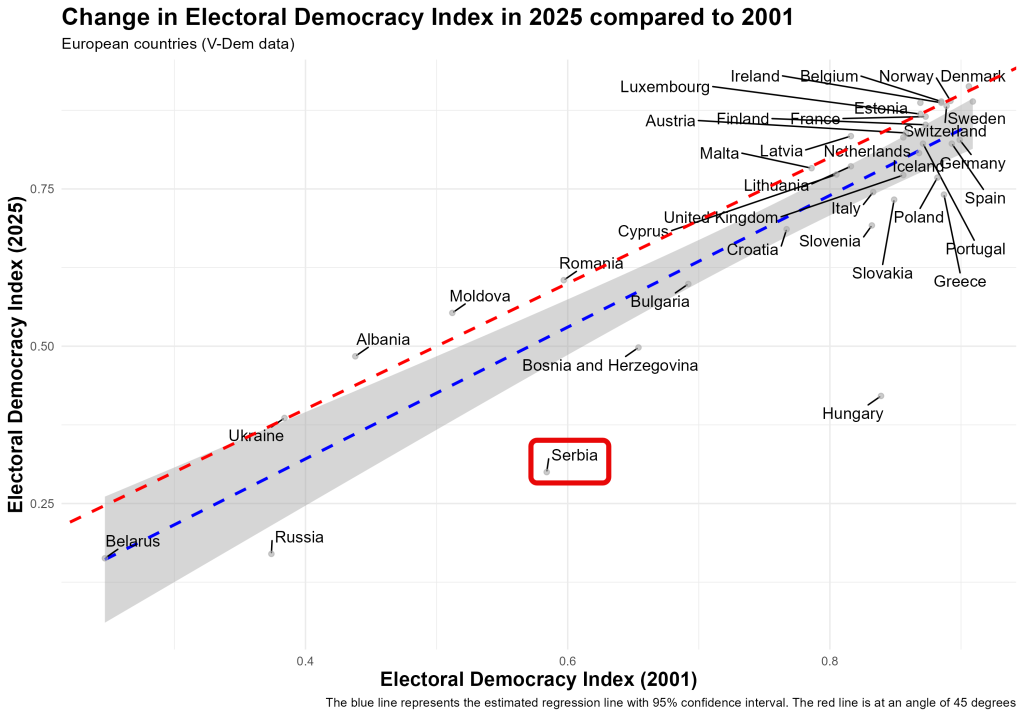
The red dashed line is the 45-degree equality line:
EDI 2025 = EDI 2001
Every point on this line represents a country whose Electoral Democracy Index was exactly the same in 2025 as in 2001. A country above the red line improved. A country below it declined.
The blue dashed line is the estimated regression line:
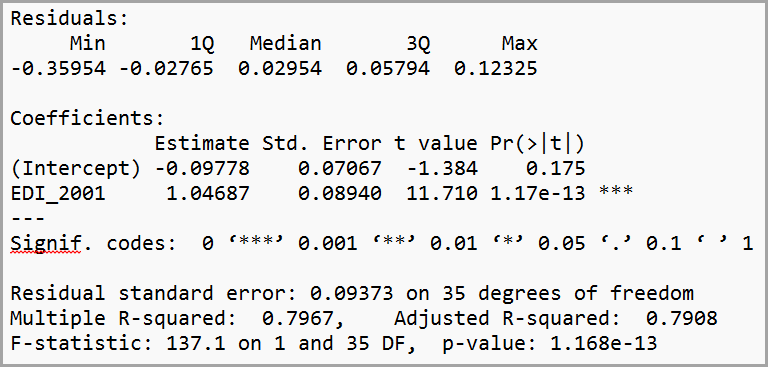
EDI 2025 = –0.09778 + 1.04687 × EDI 2001
It answers a different question. Rather than showing whether a country improved or declined relative to itself, it estimates the 2025 value normally associated with its 2001 starting position within this sample of 37 countries. A country below the blue line performed worse than the regression model predicts; a country above it performed better.
The distinction matters. A country may be below the red equality line because it declined, but above the blue regression line because its decline was smaller than the broader pattern predicted by the model. Belarus illustrates this point. Its EDI fell from 0.247 to 0.163, but its position is almost exactly on the estimated regression line. It clearly deteriorated relative to 2001, yet it did not perform substantially worse than the model predicts for a country with such a low initial value.
Conversely, Hungary, Serbia and Russia are below both lines. They experienced absolute decline and also performed substantially worse than expected from their starting positions.
The grey area around the blue line represents the 95% confidence interval for the estimated mean relationship. It is wider at the lower end of the scale, partly because relatively few countries began the period with very low EDI values.
The deepest reversals: Hungary, Serbia and Russia
Hungary experienced the largest decline in the dataset. Its Electoral Democracy Index fell from 0.839 in 2001 to 0.421 in 2025, a reduction of 0.418. Based on its starting value, the regression predicts a 2025 score of approximately 0.781. Hungary’s actual result is therefore about 0.360 below the predicted value, the largest negative residual in the sample.
This quantitative trajectory is consistent with the conclusions of the OSCE Office for Democratic Institutions and Human Rights (OSCE/ODIHR) concerning Hungary’s 2022 parliamentary elections. The elections were administered effectively, but observers found no level playing field, pervasive overlap between government and governing-coalition campaigning, and biased news coverage that restricted voters’ ability to make an informed choice. The European Commission reported in 2025 that no progress had been made in ensuring fair distribution of state advertising or strengthening the independent governance and editorial autonomy of public-service media.
Serbia recorded the second-largest decline, from 0.584 to 0.300, or –0.284. The regression predicts approximately 0.514 for a country with Serbia’s initial score. Its actual result is therefore about 0.214 below the blue line, giving Serbia the second-largest negative residual after Hungary.
OSCE/ODIHR concluded that Serbia’s 2023 parliamentary elections were technically well administered and offered political alternatives, but that the president’s decisive involvement and the ruling party’s systemic advantages created unjust conditions. Observers also reported media bias, pressure on public-sector employees and misuse of public resources. The European Commission stated in its 2025 report that tangible improvements and further electoral reforms remained necessary and that outstanding OSCE/ODIHR recommendations should be implemented transparently and well before future elections. It also identified backsliding in freedom of expression and a seriously worsening environment for journalists and media organisations.
Russia recorded the third-largest decline, from 0.374 to 0.170, a fall of 0.204. Its actual 2025 score is around 0.124 below the regression prediction. Unlike most countries in the analysis, Russia did not invite OSCE/ODIHR to observe its 2024 presidential election. ODIHR stated that this decision contradicted Russia’s OSCE commitments and denied voters and institutions an impartial and independent assessment of the election.
Bosnia and Herzegovina declined from 0.654 to 0.498, a reduction of 0.156. It is approximately 0.089 below the regression line. The European Commission’s 2025 report concluded that the general framework for elections required substantial reform, constitutional changes were necessary to guarantee political equality and non-discrimination, electoral integrity needed improvement, and political parties should respect the independence of the Central Electoral Commission.
Belarus remained the lowest-scoring country in 2025, at 0.163, followed by Russia at 0.170 and Serbia at 0.300. Belarus declined by 0.084 from its already low 2001 value. OSCE/ODIHR was unable to observe the January 2025 presidential election because the Belarusian authorities did not issue an invitation. ODIHR stated that this prevented an impartial assessment of the process and further reduced electoral transparency.
Table 1. European countries with the largest declines in the Electoral Democracy Index between 2001 and 2025. Source: V-Dem data
| Countrry | EDI_2001 | EDI_2025 | EDI_2025 – EDI_2001 |
| Hungary | 0.839 | 0.421 | -0.418 |
| Serbia | 0.584 | 0.300 | -0.284 |
| Russia | 0.374 | 0.170 | -0.204 |
| Bosnia and Herzegovina | 0.654 | 0.498 | -0.156 |
| Greece | 0.887 | 0.741 | -0.146 |
| Slovenia | 0.832 | 0.692 | -0.140 |
Below 0.600 does not describe a single democratic condition
Nine countries had an Electoral Democracy Index below 0.600 in 2025: Belarus at 0.163, Russia at 0.170, Serbia at 0.300, Ukraine at 0.386, Hungary at 0.421, Albania at 0.484, Bosnia and Herzegovina at 0.498, Moldova at 0.553 and Bulgaria at 0.599.
They should not be treated as one homogeneous group. Six of them, Belarus, Russia, Serbia, Hungary, Bosnia and Herzegovina and Bulgaria, declined between 2001 and 2025. Albania and Moldova improved moderately, while Ukraine’s increase of 0.002 is too small to support a meaningful claim of democratic progress.
Albania rose from 0.438 to 0.484, an improvement of 0.046. Its position above both the equality line and the regression line indicates improvement relative to its past and better performance than expected from its initial level. Nevertheless, the European Commission’s 2025 assessment described the parliamentary elections as competitive and professionally conducted but found that contestants did not enjoy a level playing field. It identified the widespread use of administrative resources, institutional leverage and patronage networks, together with continuing weaknesses in media independence and transparency.
Moldova improved from 0.512 to 0.553, a gain of 0.041. Its 2025 parliamentary elections offered voters a genuine choice and were professionally administered, but OSCE/ODIHR found that the process was undermined by foreign interference, illicit financing, cyberattacks and widespread disinformation. Moldova therefore represents genuine but vulnerable progress rather than completed democratic consolidation.
Ukraine moved only from 0.384 to 0.386. This almost unchanged value cannot be interpreted in the same way as changes in peacetime countries. No national elections took place during the relevant reporting period because elections are prohibited under martial law. The European Commission emphasised the need to prepare for post-war elections, including updating the voter register, protecting the political rights of displaced citizens and military personnel, countering cybersecurity and disinformation threats, and safeguarding media pluralism.
Table 2. Countries with an Electoral Democracy Index below 0.600 in 2025, showing 2001 value, 2025 value, absolute change and position relative to the regression line. Source: V-Dem data
| Country | EDI_2001 | EDI_2025 | | EDI_2025 – EDI_2001 | | Regression line |
| Belarus | 0.247 | 0.163 | 0.084 | On the line |
| Russia | 0.374 | 0.170 | 0.204 | Below |
| Serbia | 0.584 | 0.300 | 0.284 | Below |
| Ukraine | 0.384 | 0.386 | 0.002 | Above |
| Hungary | 0.839 | 0.421 | 0.418 | Below |
| Albania | 0.438 | 0.484 | 0.046 | Above |
| Bosnia and Herzegovina | 0.654 | 0.498 | 0.156 | Below |
| Moldova | 0.512 | 0.553 | 0.041 | Above |
| Bulgaria | 0.692 | 0.599 | 0.093 | Below |
Does a regression coefficient above one mean democracy improved?
No. Just as a coefficient slightly below one did not automatically prove backsliding in the previous analysis, the revised coefficient of 1.04687 does not demonstrate democratic improvement.
The coefficient indicates that differences between countries’ starting positions remained highly persistent. In simplified terms, a difference of 0.100 between two countries in 2001 is associated with an estimated difference of approximately 0.105 between them in 2025. Countries that began with relatively high EDI values generally remained above countries that began with low values.
The slope is slightly greater than one, but the regression also has a negative intercept of –0.09778. These two parameters must be interpreted together.
Across the entire possible EDI scale from 0 to 1, the estimated blue line lies below the red equality line. Mathematically, the two lines would intersect only at an EDI value of approximately 2.086, far outside the possible 0–1 range. The model therefore predicts that a country’s 2025 EDI will be lower than its 2001 value at every realistic starting point, despite the slope being greater than one.
The regression line predicts a decline of roughly 0.086 for a country beginning near Belarus’s 2001 value and approximately 0.055 for a country beginning near the highest values observed in the sample. The steeper-than-one slope does not represent general improvement. It means that the model predicts somewhat greater losses among countries that began at the lower end than among countries that began near the top.
The estimated standard error of the slope is 0.08940, producing an approximate 95% confidence interval from 0.865 to 1.228. Because the value 1 lies inside that interval, the slope is not statistically distinguishable from one. A direct test of the hypothesis that the slope equals one gives approximately t = 0.524 and p = 0.603.
The intercept is also not statistically different from zero when tested separately. However, an additional joint test based on the supplied data rejects the proposition that the regression line as a whole is identical to the equality line, an intercept of zero and a slope of one, with approximately F(2,35) = 8.13 and p = 0.0013.
This finding is consistent with the descriptive evidence: the average index declined by 0.062, the median change was –0.030, and 27 of 37 countries ended below their 2001 values.
The coefficient of determination, R², is 0.797. This means that almost 80% of the cross-country variation in EDI values in 2025 is statistically associated with the countries’ positions in 2001. It mainly demonstrates persistence: Europe’s stronger electoral democracies generally remained stronger, while weak starting positions were difficult to overcome.
The regression remains descriptive, not causal. It cannot explain why democracy declined or identify which institutions, political decisions or historical events produced the changes. Its results also depend on the selected countries, the chosen endpoint years, the bounded 0–1 scale, measurement uncertainty and unusually influential cases such as Hungary and Serbia.
Table 3. Ordinary least squares regression of the Electoral Democracy Index in 2025 on its 2001 value. Source: author’s calculation using V-Dem data.
Serbia is not last, but that is not reassuring
Serbia is not the lowest-scoring country in the sample. It is third from the bottom, above Belarus and Russia. This result is important, but it does not make Serbia’s trajectory less troubling.
Serbia experienced the second-largest absolute decline among all 37 countries, exceeded only by Hungary. It also has the second-largest negative regression residual. In other words, Serbia deteriorated sharply relative to its own position in 2001 and performed substantially worse than would normally be expected for a country with its starting value.
Serbia also began the period from a meaningfully stronger position than Belarus and Russia. Its 2001 value of 0.584 placed it above Albania, Montenegro, North Macedonia, Moldova, Romania, Ukraine, Russia and Belarus. By 2025, only Belarus and Russia remained below it.
This is why Serbia deserves special attention. Its position is not primarily the result of beginning from an extremely low democratic baseline. It reflects a substantial reversal from an intermediate European position.
The V-Dem data do not identify a single cause. Yet their long-term direction is consistent with recurring international findings concerning unequal campaign conditions, blurred boundaries between public office and party campaigning, pressure on public employees and voters, weak regulation of campaign resources, media imbalance, limited institutional oversight and insufficiently effective legal remedies.
Europe’s democratic balance sheet therefore shows neither universal collapse nor general progress. It shows strong institutional persistence combined with a broad downward shift. Many countries lost only a small part of their previous democratic position. A few improved from low starting levels. But Hungary, Serbia and Russia experienced changes large enough to transform both their national trajectories and Europe’s overall democratic distribution.
The red equality line delivers the simplest conclusion: most European countries in this sample are below where they stood in 2001. The blue regression line adds a second warning: Serbia, Hungary and Russia fell substantially further than their starting positions would lead us to expect.
What international monitors say should change
- Electoral rules should be revised transparently and inclusively, with reforms completed well before election day.
- Public institutions, official functions and government resources must be clearly separated from party campaigning.
- Election commissions, media regulators and campaign-finance oversight bodies need genuine operational independence and effective enforcement powers.
- Voter registers should be independently audited and made sufficiently transparent for meaningful public scrutiny.
- State advertising and public funding for media should be allocated through fair, transparent and politically neutral procedures.
- Public-service media need independent governance, sustainable financing and enforceable duties to provide pluralistic political coverage.
- Pressure on voters, public employees, journalists, candidates and observers must be investigated promptly and sanctioned effectively.
- Election complaints and appeals must provide timely and meaningful remedies before violations can irreversibly affect electoral outcomes.
- States should invite credible international observers early enough to assess all important phases of the election process.
Principal official sources
The numerical results were calculated from vdem_europe.CSV, and the scatterplot. Country interpretation is based principally on OSCE/ODIHR election reports and statements concerning Hungary, Serbia, Russia, Belarus and Moldova, together with the European Commission’s 2025 reports concerning Hungary, Serbia, Bosnia and Herzegovina, Albania and Ukraine.

Director of Wellington based My Statistical Consultant Ltd company. Retired Associate Professor in Statistics.
Has a PhD in Statistics and over 45 years experience as a university professor, consultant, international researcher and government advisor.