An election can be orderly without being fully democratic. Ballot papers may arrive on time, polling stations may open, votes may be counted correctly and official results may be published, yet citizens may still have been denied a genuinely equal opportunity to choose. One party may dominate television coverage. Public employees may fear consequences if they do not support those in power. Opposition parties may face unequal access to resources, while journalists, civic organisations and critical voices operate under pressure.
Election night is therefore best understood as a photograph. Electoral democracy is the entire film: the months before voting, the conduct of the campaign, access to information, the administration of the vote, the resolution of complaints and the political environment in which winners later exercise power.
This distinction is central to the Varieties of Democracy project, better known as V-Dem. Using five V-Dem indicators and data for the six former Yugoslav republics from 2001 to 2025, this article asks a deceptively simple question: what are we measuring when we say that elections are democratic?
Turning democratic experience into measurable indicators
Democracy cannot be measured as directly as temperature or distance. Researchers cannot place a thermometer inside a political system. They must first divide democracy into observable or assessable components: whether elections are competitive, whether opposition parties can organise, whether voters have access to alternative information, whether intimidation occurs and whether decisions are justified through reasoned public discussion.
V-Dem collects assessments from country experts and combines them through statistical measurement models. The resulting country-year values are estimates designed to make political conditions comparable across countries and time. They should not be read as perfectly exact grades. A movement from 0.612 to 0.607 does not necessarily mean that citizens could literally feel five thousandths less democracy. Larger, sustained and simultaneous movements across several indicators carry much more interpretive weight.
The V-Dem dataset contains four composite indices expressed between 0 and 1, with higher values representing stronger democratic performance. It also contains a fifth measure, election free and fair indicator (v2elfrfair), whose values are produced on a different latent statistical scale. Its raw values must therefore not be placed beside the four indices as though, for example, 0.5 had the same meaning on every measure.
Five ways of asking whether an election is democratic
The Electoral Democracy Index, or EDI (v2x_polyarchy), provides the broadest view. It asks whether political leaders are made responsive to citizens through meaningful electoral competition. It considers extensive suffrage, freedom of political and civic organisation, clean elections, freedom of expression, alternative information sources and whether the chief executive is selected through elections. In intuitive terms, the index asks not merely whether voting occurred, but whether voters had a real opportunity to remove one group of rulers and replace it with another.
The Election Free and Fair indicator (v2elfrfair) is narrower and more election-specific. Experts consider the pre-election period, election day and the post-election process, and then assess whether a national election was fundamentally free and fair. The indicator does not itself measure how broadly the right to vote is granted. It is converted from ordered expert responses into an interval estimate through V-Dem’s measurement model, which is why its numerical scale differs from the four indices shown in the country graphs.
The Deliberative Democracy Index (v2x_delibdem) asks how political decisions are reached. Are public arguments based on reasons and evidence? Do decision-makers consider counterarguments? Are different social and political voices consulted, or is public debate reduced to insults, loyalty tests and decisions announced after they have effectively already been made? Deliberation matters to election quality because citizens cannot make informed choices where debate is systematically distorted or dissenting arguments are excluded.
The Clean Elections Index (v2xel_frefair) measures the integrity of the electoral process. It incorporates assessments of the autonomy and capacity of electoral-management bodies, voter registration, vote buying, intimidation, electoral violence, other irregularities and whether elections are considered free and fair. “Clean” should therefore not be understood merely as the absence of falsified ballot papers. It includes the institutional safeguards that protect the vote from manipulation and coercion.
Finally, the Freedom of Expression and Alternative Sources of Information Index (v2x_freexp_altinf) asks whether the government respects media freedom, whether ordinary people can discuss political questions publicly and privately, and whether academic and cultural expression is protected. A ballot offers only a formal choice when citizens cannot obtain sufficiently pluralistic information about the available alternatives.
Serbia: decline across the entire democratic environment
Serbia presents the clearest and most comprehensive negative trajectory in the regional dataset. Between 2001 and 2025, its Electoral Democracy Index fell from 0.584 to 0.300. The Deliberative Democracy Index declined from 0.511 to 0.208, the Clean Elections Index from 0.540 to 0.212, and the Freedom of Expression and Alternative Sources of Information Index from 0.810 to 0.424. The separate election-specific v2elfrfair estimate also deteriorated, from 0.359 to –1.103 on its latent scale.
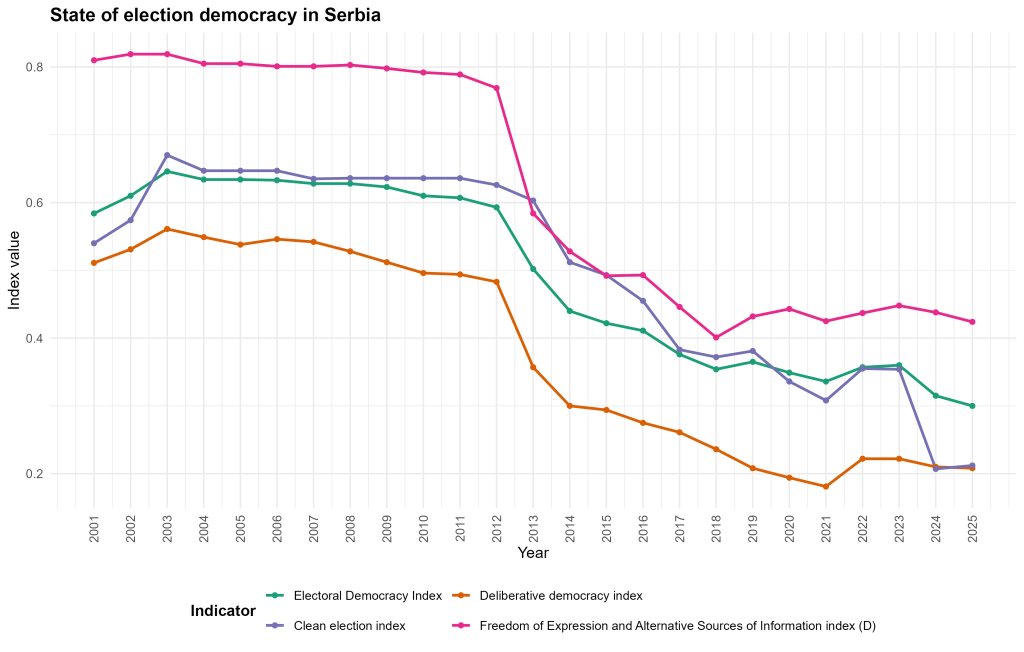
The decline is neither confined to one election nor evenly distributed across the entire period. Serbia’s indicators initially improved, with several reaching local peaks around 2002–2003. The decisive downward movement became visible after approximately 2012, particularly in expression, public deliberation and the broader Electoral Democracy Index. The Clean Elections Index subsequently fell sharply as well, reaching 0.212 in 2025.
Because all four plotted lines move downward, the graph points to more than a technical problem with election-day procedures. It suggests a mutually reinforcing process in which weaker media pluralism, less meaningful public debate, unequal campaign conditions, institutional dependence and declining election integrity affect one another.
That interpretation is consistent with the OSCE Office for Democratic Institutions and Human Rights assessment of Serbia’s December 2023 parliamentary elections. OSCE/ODIHR concluded that the elections were technically well administered and offered political alternatives, but that the president’s decisive involvement and the ruling party’s systemic advantages created unjust conditions. Its report also identified media bias, pressure on public-sector employees, misuse of public resources, ineffective oversight institutions and procedural deficiencies during voting and counting.
The European Commission’s 2025 Serbia Report similarly stated that tangible improvements and further electoral reforms remained necessary and called for all outstanding OSCE/ODIHR and Council of Europe recommendations to be implemented transparently, inclusively and well before new elections.
Six countries, six different combinations of strengths and weaknesses
Bosnia and Herzegovina also records deterioration across all four plotted dimensions, although less dramatically than Serbia. Its Electoral Democracy Index fell from 0.654 in 2001 to 0.498 in 2025. The largest decline occurred in the Clean Elections Index, from 0.762 to 0.511, while deliberative democracy and freedom of expression also weakened.
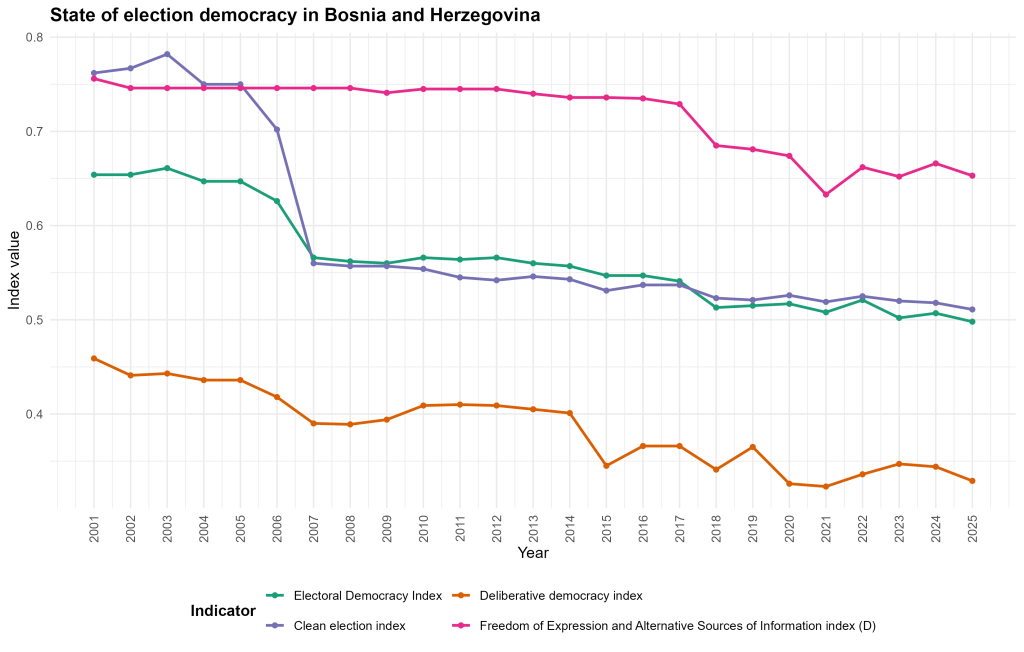
The country’s graph reflects a structural democratic problem rather than a simple failure to organise voting. OSCE/ODIHR described the 2022 general elections as generally well organised and competitive, but noted that universal and equal suffrage was still not guaranteed, public debate was limited, media coverage was sometimes biased and divisive ethnic rhetoric constrained informed choice. The European Commission continued in 2025 to call for urgent constitutional and electoral reforms capable of ensuring institutional functionality and non-discrimination.
Croatia shows why democratic indicators need to be read separately as well as together. Its Clean Elections Index rose from 0.812 to 0.875, but the Electoral Democracy Index declined from 0.767 to 0.686. Deliberative democracy fell from 0.632 to 0.499, while freedom of expression and alternative information declined from 0.929 to 0.743.
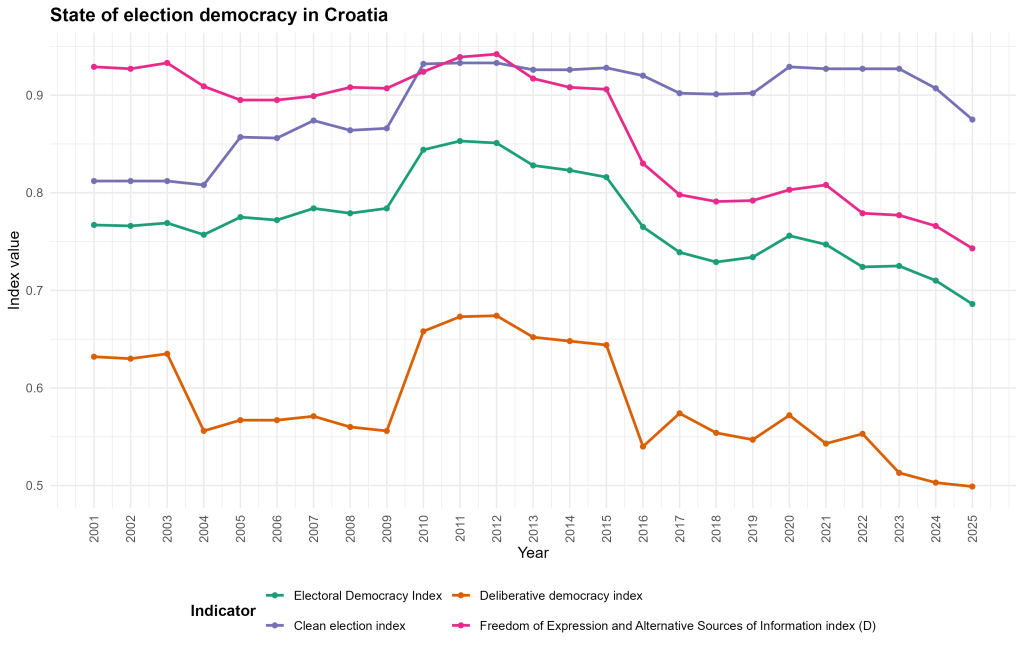
The resulting profile is not one of fundamentally fraudulent elections. OSCE/ODIHR found the 2024 parliamentary elections competitive, with a wide range of choices and broad confidence in the election administration. At the same time, it noted that many earlier recommendations remained unresolved, including those concerning voter-register accuracy, campaign oversight, campaign-finance transparency and defamation. The European Commission’s 2025 Rule of Law Report also identified continuing concerns about media freedom, pluralism and the independence of public-service media.
Montenegro is the only country in the dataset to improve between 2001 and 2025 across all four plotted indices. Its Electoral Democracy Index increased from 0.457 to 0.636, deliberative democracy from 0.352 to 0.521, clean elections from 0.417 to 0.608, and freedom of expression from 0.729 to 0.853.
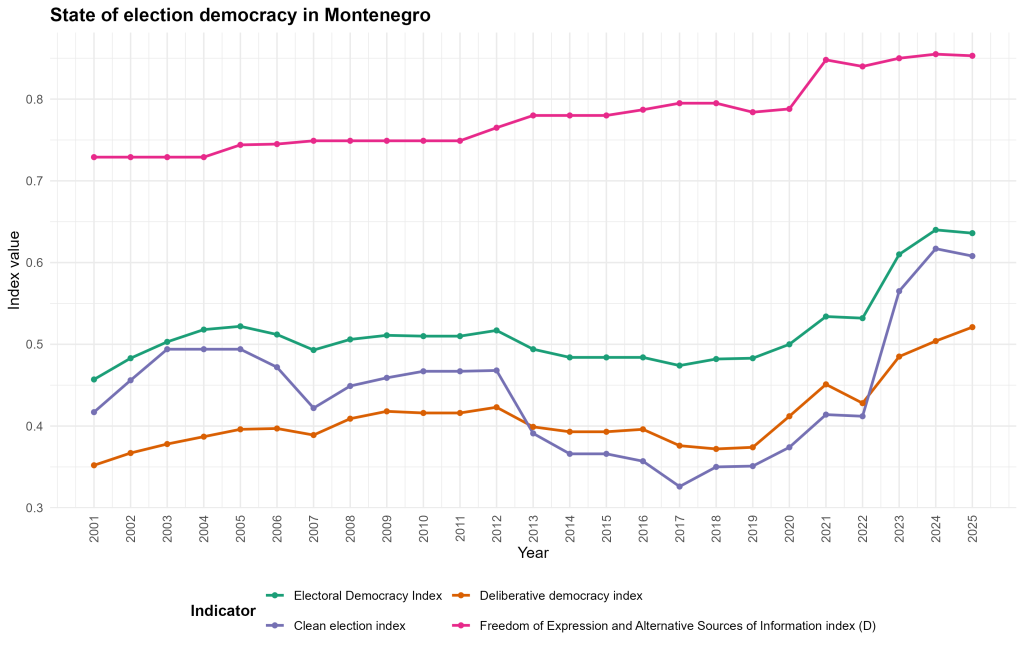
This does not mean that its electoral system is free of vulnerabilities. OSCE/ODIHR assessed the 2023 parliamentary elections as competitive, efficiently managed and offering voters a wide choice, but also described a polarised media environment, unresolved legal deficiencies, voter-register concerns and weaknesses in campaign-finance and media oversight. The European Commission reported in 2025 that some aspects of the electoral framework had been reformed through bipartisan legislation, while further revision remained necessary to align it with OSCE/ODIHR recommendations. Montenegro’s trajectory is therefore one of substantial long-term improvement accompanied by unfinished institutional work.
North Macedonia has the most visibly uneven trajectory. Between 2001 and 2025, its Electoral Democracy Index increased from 0.445 to 0.562, deliberative democracy from 0.256 to 0.372, and clean elections from 0.360 to 0.701. Freedom of expression, however, ended almost where it began: 0.674 in 2001 and 0.664 in 2025, after a marked fall in the early 2010s and a later recovery.
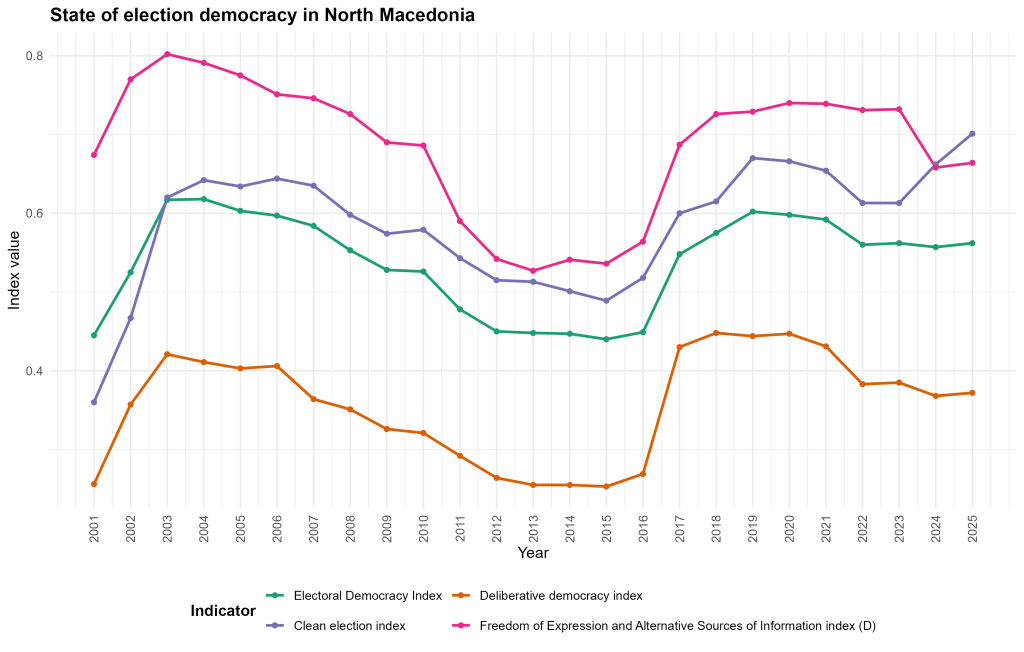
The rebound visible after approximately 2016–2017 demonstrates that deterioration is not necessarily irreversible. Yet recovery can be partial and unstable. OSCE/ODIHR found the 2024 presidential and parliamentary elections competitive and generally well administered, with voters able to make informed choices, but highlighted inadequate regulation of campaign funding and media opportunities, insufficiently effective legal remedies and procedural shortcomings. The European Commission subsequently noted that the legal framework was suitable in principle, but that electoral amendments had been adopted through a limited and non-transparent review and that outstanding recommendations remained unaddressed.
Slovenia remains among the strongest regional performers, particularly in election integrity. Its Clean Elections Index was 0.916 in 2025, only slightly below 0.929 in 2001. Nevertheless, its Electoral Democracy Index fell from 0.832 to 0.692, deliberative democracy from 0.774 to 0.612, and freedom of expression and alternative information from 0.922 to 0.691.
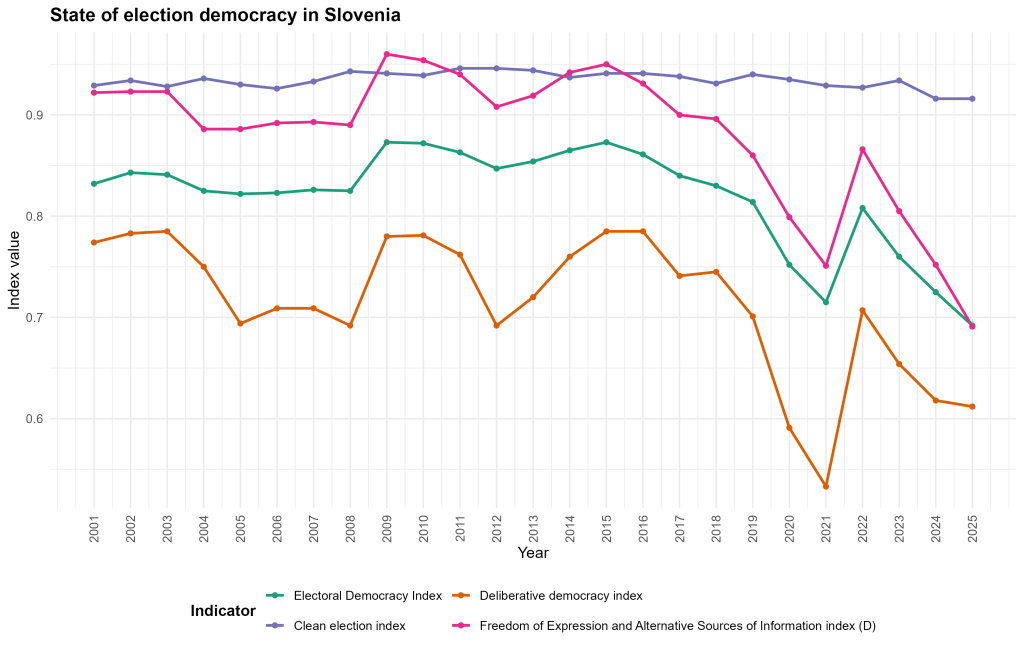
The graph therefore warns against equating clean election administration with the health of the whole democratic system. OSCE/ODIHR characterised Slovenia’s 2022 elections as competitive and pluralistic, with a professionally administered process, while also identifying political interference in public broadcasting and continued targeting of journalists. The European Commission’s 2025 assessment found that the independence of public-service media had improved following reforms, but that financial difficulties, media concentration and risks to private-media pluralism persisted.
What the four lines can, and cannot, tell us
When all four indicators move in the same direction, as they do most clearly in Serbia and Montenegro, the conclusion is stronger than one based on a single series. Serbia’s decline is broad, while Montenegro’s improvement reaches beyond election administration into information and public deliberation.
The indicators are nevertheless not four fully independent witnesses. Some share concepts and components, and the deliberative index itself incorporates the level of electoral democracy. Their convergence should therefore be read as mutually consistent evidence, not as four separate laboratory tests.
The graphs also show point estimates rather than the uncertainty intervals produced by V-Dem. Small year-to-year changes should not be overinterpreted. The strongest conclusions arise from large, persistent shifts, clear turning points and consistency between the quantitative trajectory and documented institutional developments.
The regional lesson is straightforward. Democratic elections require more than correctly counted ballots. They require credible institutions, equal political competition, free public discussion, pluralistic information and remedies that citizens and contestants can trust. Serbia’s experience demonstrates how these elements can deteriorate together. The experiences of Montenegro and North Macedonia show that improvement is possible, but also that democratic recovery remains incomplete when reforms stop halfway.
What international monitors say should change
- Implement outstanding OSCE/ODIHR recommendations through inclusive and transparent reform well before elections.
- Prevent misuse of public office, administrative resources and public-sector employment for electoral advantage.
- Strengthen the independence, powers and enforcement capacity of election, media and campaign-finance oversight bodies.
- Improve the accuracy, auditability and public scrutiny of voter registers.
- Guarantee balanced campaign coverage and protect the editorial and financial independence of public-service media.
- Ensure transparent campaign financing, effective sanctions and meaningful scrutiny of third-party campaigning.
- Protect voters, journalists, observers and public employees from intimidation, retaliation and political pressure.
- Make complaints and appeals timely, transparent and capable of providing an effective legal remedy.
Principal official sources
The quantitative analysis uses vdem_yugoslav_successor_states_data.CSV (can be downloaded from the link below) and the accompanying country graphs. Indicator definitions are based on the V-Dem Codebook, Version 16. Documentary interpretation draws on OSCE/ODIHR final election reports for Serbia, Bosnia and Herzegovina, Croatia, Montenegro, North Macedonia and Slovenia, together with the European Commission’s 2025 enlargement and Rule of Law reports.

Director of Wellington based My Statistical Consultant Ltd company. Retired Associate Professor in Statistics.
Has a PhD in Statistics and over 45 years experience as a university professor, consultant, international researcher and government advisor.