A country can improve compared with its own past and still remain behind its neighbours. It can also retain one of the region’s strongest election administrations while losing ground in media freedom, public debate and the broader conditions of political competition. This is why the country-by-country perspective used in the first part of this series is not sufficient on its own. To understand where electoral democracy is moving, each democratic dimension must also be compared across all six former Yugoslav republics.
The four graphs in this article provide that comparative perspective. They follow the Electoral Democracy Index, the Deliberative Democracy Index, the Clean Elections Index, and the Freedom of Expression and Alternative Sources of Information Index from 2001 to 2025. All four are expressed between 0 and 1, with higher values representing stronger performance. They are estimates rather than exact measurements, and the supplied graphs do not show V-Dem’s uncertainty intervals. Small differences should therefore be interpreted carefully, while large and persistent gaps deserve considerably greater attention. V-Dem itself stresses that electoral democracy is multidimensional: it depends not only on voting procedures but also on political competition, civic freedoms, information and the ability of elections to make rulers responsive to citizens.
International reports do not assign V-Dem scores. The findings of the Office for Democratic Institutions and Human Rights of the Organization for Security and Co-operation in Europe, OSCE/ODIHR, and the European Commission are therefore used here as documentary context. They help us understand which real-world institutional conditions are consistent with the movements visible in the graphs.
Electoral democracy: Serbia breaks away from the region
The Electoral Democracy Index offers the broadest of the four comparisons. In 2001, Slovenia and Croatia occupied the two leading positions, followed by Bosnia and Herzegovina and Serbia. Montenegro and North Macedonia started from lower levels. By 2025, the ordering had changed considerably: Slovenia remained first at 0.692, narrowly ahead of Croatia at 0.686, while Montenegro had risen to 0.636 and overtaken both North Macedonia, at 0.562, and Bosnia and Herzegovina, at 0.498. Serbia was last by a substantial margin, at 0.300.
Montenegro recorded the largest long-term improvement, rising by 0.179. North Macedonia also improved, by 0.117, although its path included a substantial decline during the first half of the 2010s and a later recovery. Croatia and Slovenia remained the regional leaders but ended below their 2001 values. Bosnia and Herzegovina declined gradually, while Serbia experienced the most severe reversal: a fall of 0.284.
The significance of Serbia’s trajectory lies not only in the size of the decline but also in its separation from the rest of the region. Serbia’s index was still close to 0.600 in 2012. It fell below Bosnia and Herzegovina, Montenegro and North Macedonia during the following years and never recovered. This is consistent with OSCE/ODIHR’s conclusion that Serbia’s 2023 parliamentary elections, although technically well administered and offering political alternatives, were dominated by the president’s involvement and the ruling party’s systemic advantages. The observers also reported media bias, pressure on public-sector employees and misuse of public resources. The European Commission subsequently identified the separation of state and party, the voter register, campaign oversight and financing, and media freedom among the priority areas requiring reform.
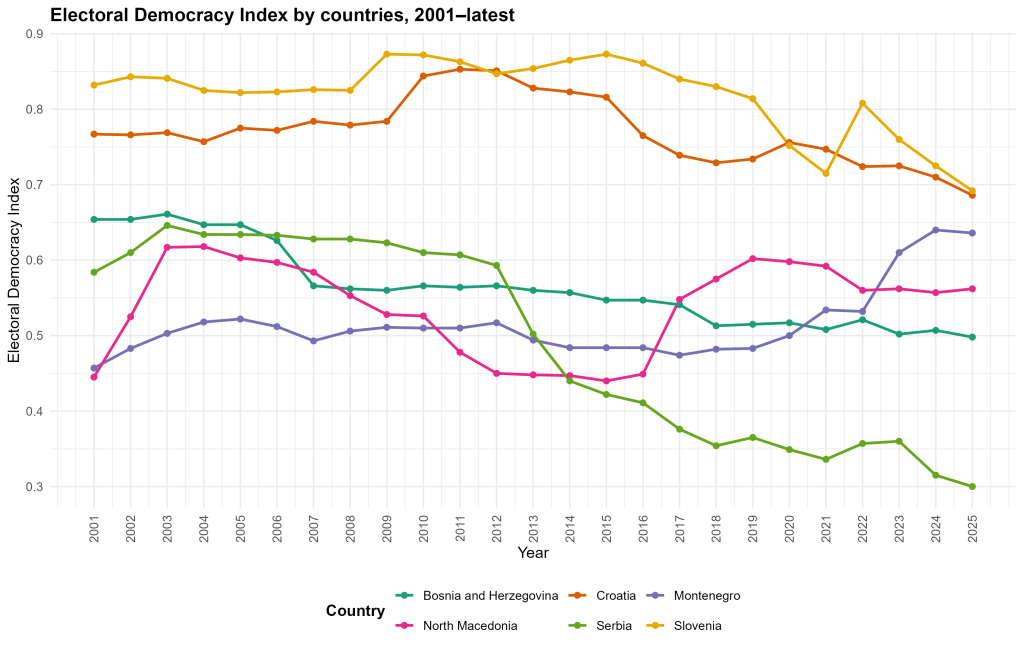
Montenegro moved in the opposite direction. Its improvement accelerated after 2020 and by 2024 it had almost reached Croatia and Slovenia. OSCE/ODIHR described its 2023 parliamentary elections as competitive and offering a wide range of choices, while the European Commission noted that later legislative amendments partially addressed recommendations concerning campaign-finance and media oversight and the integrity of election administration. However, both institutions continued to identify unfinished work, particularly concerning political spending, abuse of state resources and the need for inclusive electoral reform.
North Macedonia’s partial recovery is also reflected in international assessments. OSCE/ODIHR found that its 2024 presidential and parliamentary elections were competitive and enabled informed choice, but criticised inadequately regulated campaign funding and media opportunities that disproportionately favoured the major parties. Bosnia and Herzegovina’s weaker position reflects a different combination of problems: elections can be competitive and efficiently administered while constitutional discrimination, political fragmentation and weak institutional functionality continue to restrict equal democratic participation.
Deliberative democracy: elections without meaningful conversation
The Deliberative Democracy Index changes the question. Instead of asking primarily whether citizens can replace their rulers, it asks whether public decisions are preceded by reasoned discussion, consultation and serious consideration of competing arguments.
In 2025, Slovenia remained the regional leader at 0.612, followed by Montenegro at 0.521 and Croatia at 0.499. North Macedonia stood at 0.372, Bosnia and Herzegovina at 0.329, and Serbia at only 0.208. Montenegro again showed the strongest long-term improvement, increasing by 0.169, while North Macedonia gained 0.116. Serbia recorded by far the largest decline, falling by 0.303.
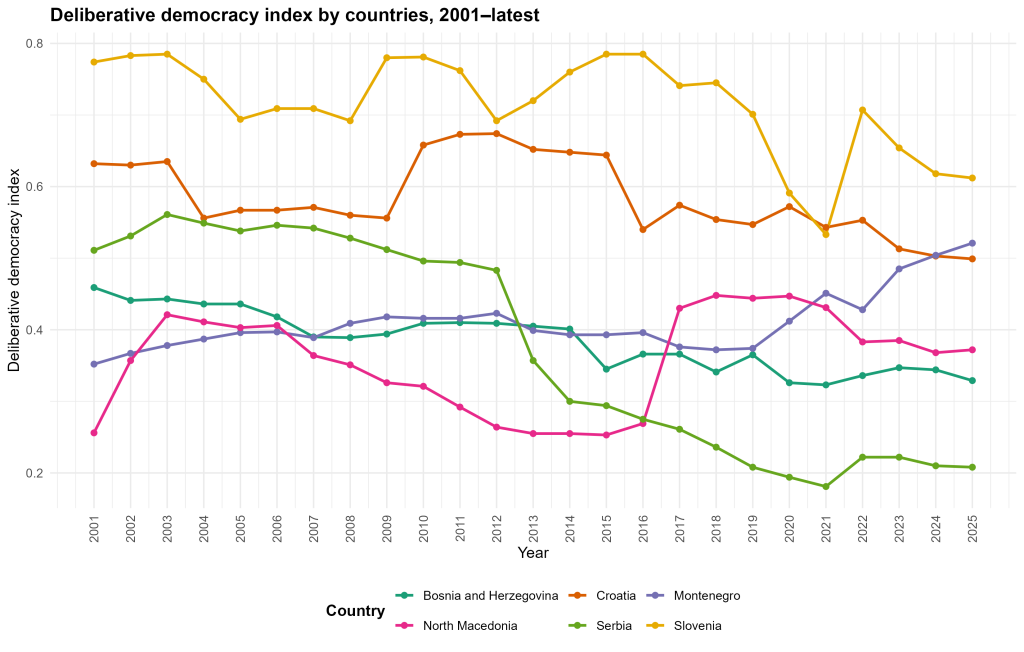
The graph reveals that Serbia’s deliberative deterioration began earlier and went deeper than its decline in some strictly procedural indicators. Its value fell sharply after 2012 and reached its minimum in 2021. This pattern suggests that the democratic problem cannot be reduced to irregularities at polling stations. It also concerns the quality of political communication, the treatment of opposing arguments and the extent to which institutions provide meaningful scrutiny.
The European Commission reported in 2025 that Serbia’s parliamentary effectiveness and oversight remained constrained, while recurrent statements by senior officials about journalists had a chilling effect on expression. In Bosnia and Herzegovina, the Commission described weak parliamentary oversight, deteriorating governance, political capture and insufficient systematic consultation with civil society. These are not direct measurements of the V-Dem deliberative index, but they describe precisely the institutional environment in which reasoned and inclusive debate becomes difficult.
Montenegro’s rise above Croatia by 2025 is noteworthy. It reflects a broader political opening and a more competitive distribution of power than existed at the beginning of the period. Yet the European Commission’s insistence that reforms should be transparent and inclusive shows that improved political competition does not automatically guarantee high-quality deliberation. North Macedonia presents a similar lesson: its recovery after 2016 was substantial, but the adoption of electoral changes without sufficient transparency and public consultation remained a recurring concern.
Clean elections: the widest regional divide
The Clean Elections Index produces the clearest separation between countries with robust electoral procedures and those where election integrity has become a central democratic vulnerability.
Slovenia led the region in 2025 with 0.916, followed by Croatia with 0.875. North Macedonia reached 0.701, Montenegro 0.608 and Bosnia and Herzegovina 0.511. Serbia again ranked last, at only 0.212.
North Macedonia achieved the largest improvement between 2001 and 2025, gaining 0.341. Montenegro improved by 0.191 and Croatia by 0.063. Slovenia remained almost unchanged at a very high level. In contrast, Bosnia and Herzegovina fell by 0.251 and Serbia by 0.328.
Croatia and Slovenia demonstrate that strong election administration can survive even when other democratic dimensions weaken. OSCE/ODIHR found Croatia’s 2024 parliamentary elections competitive, with a sound legal basis and broad confidence in the election administration. It nevertheless called attention to unresolved issues involving the voter register, campaign oversight and financing. Slovenia’s 2022 elections were also assessed as competitive and pluralistic, with contestants able to campaign freely and voters offered a broad political choice.
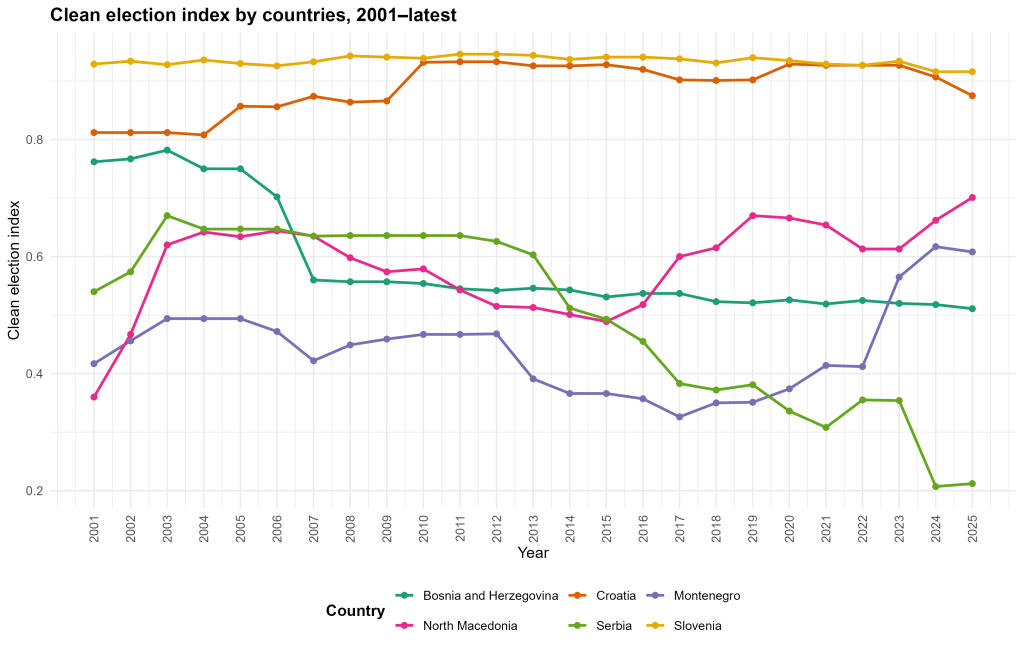
North Macedonia’s high 2025 score is consistent with the generally positive assessment of its election-day procedures in 2024. However, OSCE/ODIHR noted that some election boards did not fully follow counting procedures and called for investigations of allegations involving vote buying and misuse of public resources. This illustrates an important point: a relatively strong index does not mean that every vulnerability has been eliminated.
The cases of Bosnia and Herzegovina and Serbia are more troubling. Bosnia and Herzegovina’s electoral reforms improved some aspects of integrity, but the European Commission still judged that the general electoral framework required substantial reform and that the independence of the Central Electoral Commission should be respected. Serbia’s decline is much sharper. The gap between Serbia and every other country widened dramatically in 2024 and remained almost unchanged in 2025. This indicates not an isolated administrative defect but an accumulation of concerns about intimidation, institutional independence, the separation of public office from party campaigning, voter-register confidence, media conditions and the effectiveness of legal remedies.
Freedom of information: the hidden primary election
Before citizens choose between parties, they effectively participate in another contest: the contest over which facts, voices and political alternatives they are permitted to see and hear. This is why freedom of expression and access to alternative information are part of election quality, not a separate luxury added after voting.
Montenegro ranked first on this index in 2025, at 0.853. Croatia followed at 0.743, Slovenia at 0.691, North Macedonia at 0.664 and Bosnia and Herzegovina at 0.653. Serbia was again last, at 0.424.
Montenegro was the only country to record a clear long-term improvement, gaining 0.124. North Macedonia ended close to its 2001 value after first declining and then recovering. Bosnia and Herzegovina, Croatia and Slovenia all lost ground. Serbia’s decline of 0.386 was the largest in the region.
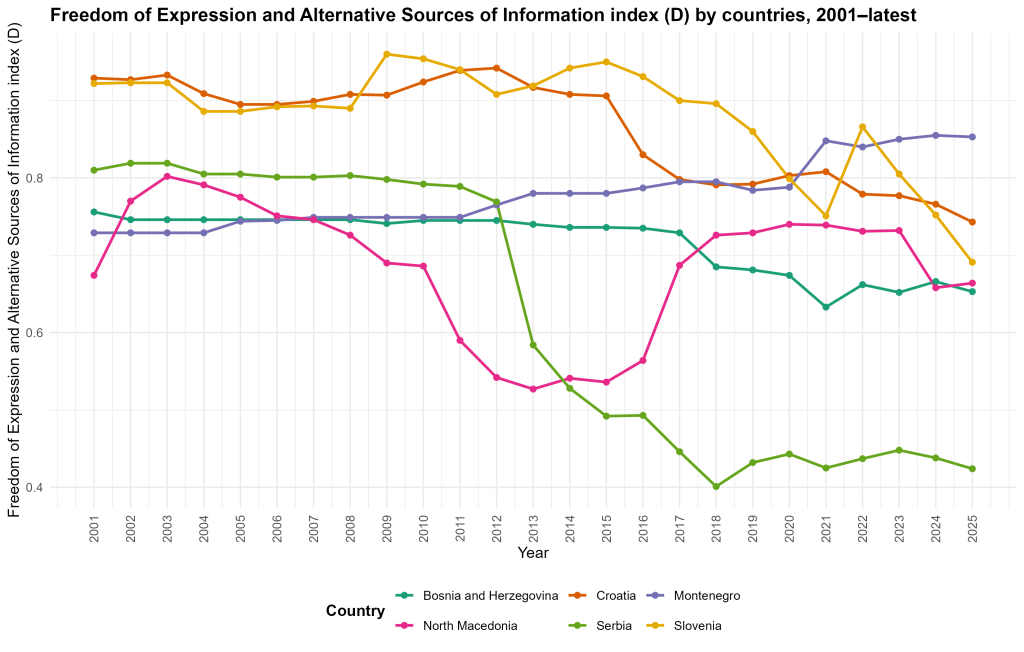
The European Commission described Montenegro’s media environment as pluralistic and considered the legal guarantees for expression broadly adequate. In North Macedonia, it acknowledged some progress but continued to raise concerns about media-ownership transparency, the public broadcaster and the possible misuse of political funds through state advertising.
Croatia and Slovenia show why even comparatively pluralistic systems require continuing protection. The Commission reported that Croatia had not yet established sufficiently fair and transparent rules for allocating state advertising and that journalists continued to face strategic lawsuits. In Slovenia, reforms improved the independence of public-service media, but financial instability, concentrated private-media ownership and uncertainty over sustainable funding remained significant risks.
Serbia again stands apart. The Commission described backsliding in freedom of expression, a seriously worsened environment for journalists, increasing strategic lawsuits and persistent concerns about the independence of the media regulator. When one country combines the region’s lowest scores for clean elections, deliberation and alternative information, the problem is no longer simply whether votes are counted correctly. It is whether political competition remains meaningfully open before the count begins.
Four regional profiles
The four comparisons produce distinct democratic profiles. Slovenia and Croatia retain the region’s strongest election-integrity systems, but their declines in deliberation and information freedom show that technically credible elections do not protect every other democratic institution automatically.
Montenegro represents broad improvement. It rose across all four dimensions and by 2025 had become a serious regional comparator rather than a permanent laggard. Its challenge is to consolidate that progress through transparent campaign financing, effective oversight and protection against misuse of state resources.
North Macedonia represents recovery with unfinished foundations. Election integrity improved markedly and the broader Electoral Democracy Index recovered, but media regulation, deliberation and equality of campaign opportunity remain less secure.
Bosnia and Herzegovina represents prolonged institutional stagnation. Its elections retain meaningful competition, but constitutional inequality, fragmented governance, political capture and weakening media conditions prevent that competition from producing stronger electoral democracy.
Serbia represents broad-based democratic decline. It is not merely last on one indicator. It is last on all four in 2025, and the distance separating it from the other five countries is greatest precisely in the areas most important for informed and equal political choice. The principal lesson of the comparison is therefore uncomfortable but clear: election quality deteriorates long before the first suspicious ballot appears. It deteriorates when information, institutions, resources and public debate cease to provide contestants with a genuinely open field.
What international monitors say should change
- Electoral laws should be revised through inclusive public consultation and completed well before an election begins.
- Governments should establish a clear separation between state institutions, public office and party campaigning and prevent pressure on public employees and voters.
- Election-management bodies and supervisory institutions need operational independence, sufficient resources and transparent appointment procedures.
- Voter registers should be regularly audited, publicly scrutinised and corrected through clear procedures.
- Campaign income, spending and third-party activity should be disclosed promptly and monitored by institutions able to impose effective and proportionate sanctions.
- Public and private media should provide pluralistic election coverage, while media regulators and public broadcasters require genuine political and financial independence.
- Media ownership and state advertising should be transparent, and journalists should be protected from threats, violence and abusive lawsuits.
- Complaints and appeals must be resolved rapidly, transparently and by institutions capable of providing an effective remedy before electoral disputes lose their practical significance.
Principal official sources
The quantitative findings are calculated from vdem_yugoslav_successor_states_data.CSV and the four comparative figures. Definitions and methodological interpretation follow the V-Dem Codebook, Version 16. The documentary assessments draw on official OSCE/ODIHR final reports and summaries for the most recent relevant national elections in the six countries, together with the European Commission’s 2025 enlargement reports and Rule of Law country chapters.

Director of Wellington based My Statistical Consultant Ltd company. Retired Associate Professor in Statistics.
Has a PhD in Statistics and over 45 years experience as a university professor, consultant, international researcher and government advisor.