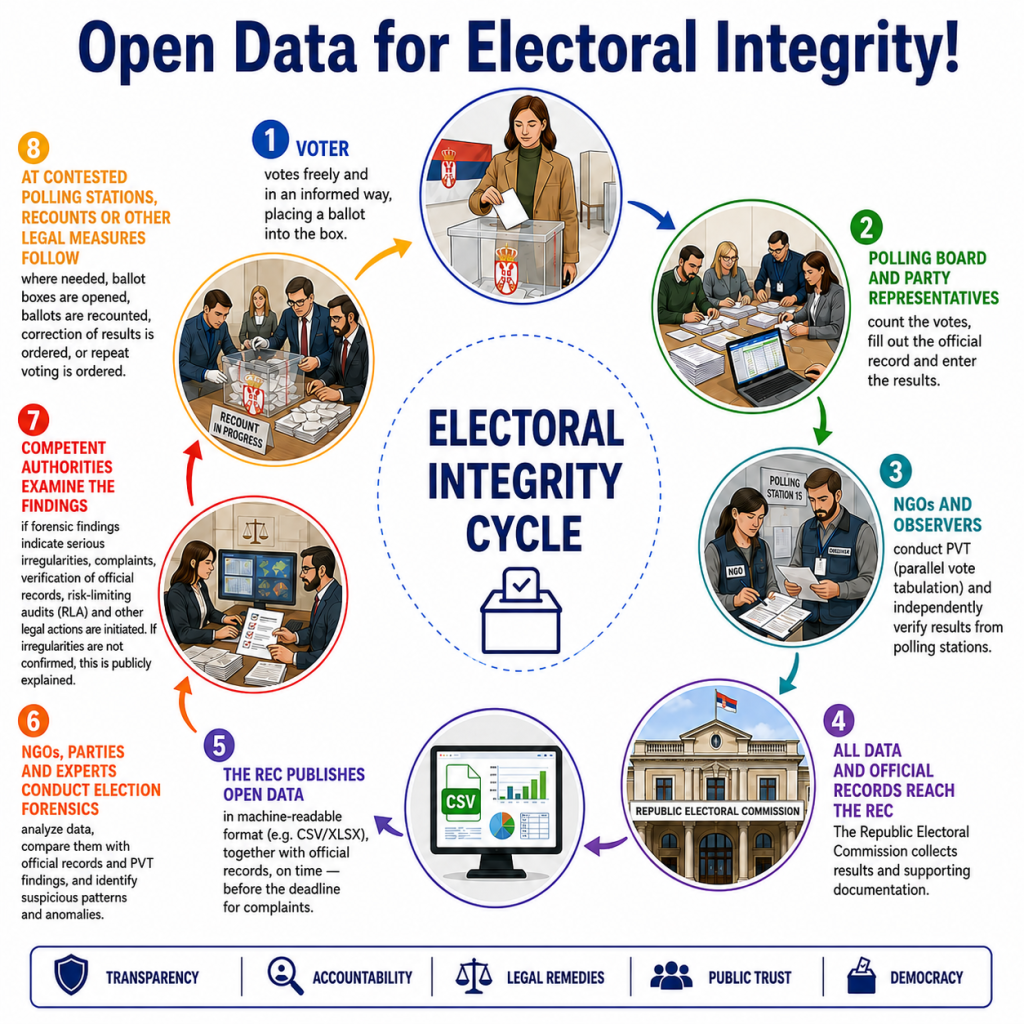
Electoral integrity does not begin and end on election day. It is a cycle in which every step must leave a trace: voting, counting, official records, data publication, independent analysis, institutional review and, where necessary, legal remedies. If one part of the cycle is missing, public trust weakens. If the cycle works, the election result is not merely announced — it becomes verifiable.
Step 1: Voter
Description.
Everything starts with the voter, who must be able to vote freely and in an informed way. This means that citizens should not face pressure, intimidation, blackmail or systematic manipulation of information. Secrecy of the vote and freedom of choice are not decorative principles; they are the foundation of the entire electoral process.
Task/Actors.
The task is to ensure free, secret and informed voting. Actors: voters, polling boards, election commissions, media, observers, political parties, regulatory bodies.
Step 2: Polling Board and Party Representatives
Description.
After the polling station closes, the technically routine but politically crucial phase begins: counting votes and completing the official record. The official record is the first institutional link between the ballots in the box and the final election result. If it is inaccurate, incomplete, unclear or changed without a trace, the chain of trust becomes fragile.
Task/Actors.
The task is to count ballots correctly, complete the official record, register objections and enter results. Actors: polling boards, party/list representatives, observers, local election commissions.
Step 3: NGOs and Observers
Description.
Independent observers are not merely passive witnesses on election day. They can collect polling-station data, photograph official records where permitted and conduct PVT, or parallel vote tabulation. PVT is not an exit poll: it does not ask voters whom they supported; it verifies the results recorded at polling stations.
Task/Actors.
The task is to create an independent evidence stream that can be compared with official results. Actors: NGOs, observer organisations, trained observers, statisticians, data teams.
Step 4: All Data and Official Records Reach the REC
Description.
The Republic Electoral Commission collects results and supporting documentation. At this stage, it must be clear where each data point came from, when it was entered, whether it was changed and which official record supports it. Centralisation of results should not become a black box; it should be a documented process.
Task/Actors.
The task is to collect, verify and consolidate polling-station results and documentation. Actors: Republic Electoral Commission, local election commissions, administrative teams, IT teams, observers.
Step 5: The REC Publishes Open Data
Description.
This is the key reform step. Results should be published by polling station, in a machine-readable format such as CSV or XLSX, together with scanned official records. Most importantly, they must be published on time — before the deadline for complaints — because data published too late can no longer support an effective legal remedy.
Task/Actors.
The task is to publish a complete, clean, documented and downloadable database of results. Actors: REC, IT services, freedom-of-information institutions, NGOs, media, researchers.
Step 6: NGOs, Parties and Experts Conduct Election Forensics
Description.
Once data are open, fast and independent analysis becomes possible. NGOs, parties, journalists and experts can check whether totals add up, whether inconsistencies exist, whether the central database matches official records and whether suspicious patterns appear. At this stage, election forensics does not deliver a final judgment; it raises verifiable questions.
Task/Actors.
The task is to analyse data, compare them with official records and PVT findings, and identify anomalies that require verification. Actors: NGOs, political parties, statisticians, data analysts, journalists, academics, IT experts.
Step 7: Competent Authorities Examine the Findings
Description.
If forensic analysis points to serious irregularities, the next step must be institutional, not merely media-driven. Competent authorities should examine the findings, verify official records, consider complaints and, where appropriate, conduct risk-limiting audits. If irregularities are not confirmed, this should also be publicly explained — because dismissing a suspicion should itself be transparent.
Task/Actors.
The task is to turn a forensic signal into a law-based verification process. Actors: REC, local election commissions, courts, legal experts, observers, audit experts, political parties.
Step 8: At Contested Polling Stations, Recounts or Other Legal Measures Follow
Description.
If serious discrepancies are confirmed, the system must produce consequences. These may include recounts, correction of results, inspection of election materials, additional audits or repeat voting at specific polling stations. Without legal remedies, election forensics remains an interesting analysis; with legal remedies, it becomes part of democratic protection.
Task/Actors.
The task is to apply the appropriate legal measure where irregularities are confirmed. Actors: election commissions, courts, political parties, observers, legal teams, the public.
Conclusion
Open election data are not a technical detail. They are the first realistic step toward a system in which election results can be checked quickly, publicly and lawfully. Verifiability is not useful only to the opposition, nor is it harmful to the authorities. It serves everyone: citizens, institutions and the legitimacy of the result itself. A result that can be verified is stronger than a result that is merely announced.

Director of Wellington based My Statistical Consultant Ltd company. Retired Associate Professor in Statistics.
Has a PhD in Statistics and over 45 years experience as a university professor, consultant, international researcher and government advisor.