Introduction
A commentator on X recently sent me a table comparing the results of the ruling party and turnout across several municipalities and across different election cycles.
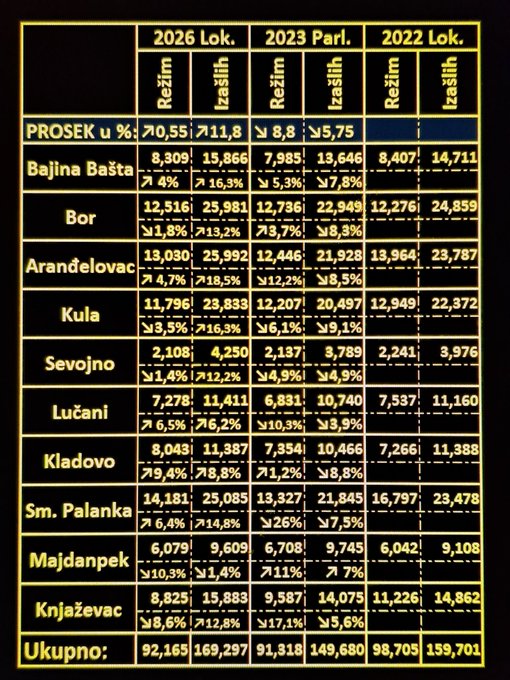
The table is interesting and politically suggestive, but it also raises several methodological problems that deserve careful attention before any strong conclusion is drawn. In this post, I offer a few constructive comments that may help readers better understand what it actually means to say that the ruling party “gained” or “lost” support in a particular municipality. I also address another idea, namely, that this kind of local-level comparison could be translated into a forecasting tool for the forthcoming parliamentary elections. In my view, that would be analytically risky. Local and parliamentary elections do not ask the same political question, and raw changes in votes or turnout cannot be interpreted mechanically across such different electoral settings.
Local vs parliamentary elections (comparison)
On the comparison issue: it is not recommended to treat gains or losses in ruling-party votes on a local election as directly comparable to a parliamentary election. The electoral arena is different. In local elections, voters are often reacting to local candidates, municipal problems, personal networks, service delivery, and specific community grievances. In parliamentary elections, the frame is broader: national leadership, macro-politics, party brand, coalition logic, foreign policy, economy, and national media narratives. So a rise or fall in votes between those two election types does not necessarily mean the ruling party truly “gained” or “lost” support in the same substantive sense. It may simply reflect that voters were answering a different political question.
Absolute vs relative indicators
The table mixes elections with different totals in both the number who voted and the number who voted for the ruling side. That means raw vote changes are not on equal footing. A municipality can show more votes for the ruling party simply because turnout was higher, not because ruling-party support deepened. Or it can show fewer raw votes while actually improving its competitive position if turnout fell sharply overall. So comparing absolute counts alone is misleading.
A more accurate comparison depends on what exactly you want to measure.
If you want to know whether the ruling party became electorally stronger in the local arena, the best comparison is: 2026 local vs 2022 local, municipality by municipality, because that keeps the election type constant.
And even then, do not rely only on raw votes. Use at least these two normalized measures:
- vote share among registered voters: (V/E)
This shows how much of the full electorate the ruling party actually converted into votes. - vote share among those who voted: (V/T) or share among valid votes
This shows the ruling party’s competitive position among actual participants.
The strongest approach is to use both together:
- (V/E) tells you about mobilization reach
- (V/T) tells you about competitive dominance among voters who showed up
An even better comparison is to decompose the change into:
- change in turnout,
- change in ruling-party conversion of turnout,
- change in opposition share,
- change in ruling-opposition margin.
So instead of asking only “Did the ruling party gain or lose votes?”, ask:
- Did it gain or lose share of registered voters?
- Did it gain or lose share of actual voters?
- Did its margin over the opposition widen or narrow?
- Was the raw change mostly a turnout effect or a persuasion/preference effect?
My recommendation would be. Use 2026 local vs 2022 local as the main comparison, and report for each municipality:
- raw ruling-party votes,
- turnout,
- ruling-party share of registered voters,
- ruling-party share of voters / valid votes,
- ruling-vs-opposition margin.
That puts all elections on a much fairer analytical basis than comparing local and parliamentary totals directly.