1. The comparative question
Some countries publish election data in ways that make independent verification almost immediate. Others publish results, but in formats that require days of manual work before meaningful analysis can begin. Still others display results on attractive dashboards without allowing citizens, journalists or observers to download the underlying data. These differences matter because election transparency is not only a question of whether results are announced. It is a question of whether those results can be independently checked.
The standard should be especially demanding in countries where elections are formally competitive but public trust is fragile. In consolidated democracies, citizens may accept decentralised administration or slower publication because the system has repeatedly proved its credibility. In hybrid or partially democratic regimes, that credibility cannot be assumed. It has to be built, election by election. For that reason, NGOs and observer coalitions in low-trust systems are justified in asking for more than might be considered necessary in stable democracies: polling-station-level data, machine-readable files, public dashboards, scanned protocols, timestamps, downloadable datasets and independent verification channels.
This second part of the series compares selected countries from Latin America, Africa, Europe and established democracies. The aim is not to produce a beauty contest of electoral systems. The aim is more practical: which countries provide election data in a form that allows real-time accountability and rapid forensic analysis? The answer is more complex than a simple democracy ranking. Some highly democratic countries have decentralised election administration and weak centralised polling-station-level datasets. Some countries that have experienced serious electoral mistrust have built stronger public result portals, observer networks or real-time dashboards precisely because they needed to limit the space for manipulation.
Serbia is placed inside this comparative frame. The key issue is not whether some election documents are public. The issue is whether polling-station-level data are available quickly, cleanly and in a format that allows observers and analysts to act before legal deadlines expire. In the twenty-first century, scanned PDFs are not enough.
2. How the comparison was made
The comparison uses a selected sample rather than a universal global ranking. The sample includes Serbia, regional comparators, strong official-data examples, African and Latin American cases, consolidated democracies and countries where observer coalitions have played an important role. The sample is deliberately mixed because the purpose is not to prove that one region or regime type is always better. The purpose is to identify different models of election-data availability.
The key outcome variable is forensic-readiness. This is not a democracy score. It measures whether election data are published quickly, at the lowest useful level, in a format suitable for independent forensic analysis. A country can therefore be democratic but still weak on centralised polling-station-level data. The United States is the clearest example: the Federal Election Commission states that it has no jurisdiction over voting laws, voter fraud or election results, because US elections are primarily governed by state law and administered at state and local level.
The UK is a similar cautionary case. The House of Commons Library provides detailed 2024 general election results and election data, but these are constituency-level and candidate-level resources, not a single national polling-station-level dataset ready for forensic analysis. This does not mean that UK elections are weak. It means that the country’s data-publication model is not designed around rapid centralised polling-station-level forensics.
The opposite pattern is visible in Brazil, South Africa and Croatia. Brazil’s Superior Electoral Court provides ballot-box bulletin data through its open-data portal, including CSV resources and hash files. South Africa’s Electoral Commission provides live result dashboards and downloadable reports, with report levels including voting district. Croatia’s State Electoral Commission explicitly states that election-result data are available in XLSX and CSV formats.
The comparison also uses contextual indicators: Freedom House total score, V-Dem Electoral Democracy Index, internet penetration, Transparency International’s CPI and Reporters Without Borders’ press freedom score. Freedom House measures political rights and civil liberties; V-Dem provides democracy indices including the Electoral Democracy Index; Transparency International’s CPI ranks perceived public-sector corruption on a 0–100 scale; and the World Bank provides GDP and internet-use indicators.
3. The forensic-readiness scale
The forensic-readiness scale has six levels.
Table 1. Forensic-readiness scale
| Level | Label | Meaning |
|---|---|---|
| 0 | Closed or unavailable data | No polling-station-level results publicly available. |
| 1 | Symbolic transparency | Results are public mainly as scanned PDFs, images, or fragmented documents requiring manual entry. |
| 2 | Basic transparency | Polling-station-level results are available, but delayed, fragmented, poorly structured, or requiring substantial cleaning. |
| 3 | Machine-readable transparency | Polling-station-level or near-equivalent results are available in CSV/XLSX/XML/structured HTML/API, but not necessarily immediate or fully forensic-ready. |
| 4 | Forensic-ready transparency | Clean, downloadable, documented polling-station-level data are available with key forensic variables. |
| 5 | Real-time forensic transparency | Level 4 plus live/near-live official dashboards, timestamps, strong public access, and/or independent cross-checking. |
This scale is regime-neutral in measurement but regime-sensitive in interpretation. The same score does not have the same political meaning everywhere. A Level 2–3 score in the United States or United Kingdom reflects decentralisation and reporting tradition. A Level 1–2 score in Serbia has a sharper meaning because Serbia is a low-trust electoral environment. In such a context, data openness is not only an administrative convenience; it is a trust-building mechanism.
4. What the comparative table shows
The comparative evidence suggests four broad groups.
Table 2. Comparative evidence
| Country | Election / data source examined | Trust context | Official live or near-live results | Polling-station / lowest-unit results | Main format | NGO / observer role | Forensic-readiness level | Interpretation |
|---|---|---|---|---|---|---|---|---|
| Brazil | 2022 national and 2024 municipal election-data infrastructure | Democratic / strong official electoral-data infrastructure | Strong official digital results infrastructure; open-data portal provides detailed election resources | Yes. TSE publishes “Boletim de Urna” datasets by state, including CSV resources and hash files | CSV / ZIP resources, hash files, open-data portal | NGO role exists but official infrastructure is the main transparency mechanism in this table | 5 | Brazil is a benchmark case for official open electoral data. The TSE open-data portal and ballot-box bulletin datasets make it one of the strongest examples of machine-readable election-result publication. (Portal de Dados Abertos do TSE) |
| Mexico | 2024 federal elections; PREP and SICEE | Democratic / high-capacity electoral authority, with politically contested elections | Yes. PREP 2024 began publication on election night at 20:00 and provides a database section | Yes. INE’s SICEE provides detailed election statistics and the PREP database supports preliminary result analysis | PREP database; SICEE web system; downloadable/database-style resources | Civil society and observers are relevant, but the verified source base here is official INE infrastructure | 4–5 | Mexico is a strong case, but the final distinction between Level 4 and Level 5 should depend on testing whether the downloadable files are immediately usable in R/Python at polling-station/casilla level. (Prep 2024) |
| South Africa | 2024 National and Provincial Elections | Democratic / official transparency infrastructure | Yes. IEC states that live results dashboards are updated every 5–10 minutes after all voting stations close | Yes. IEC dashboards and downloadable reports include lower-level result exploration, including voting-district-level material | Dashboard plus PDF, Excel, CSV downloads | Media and civic actors use IEC data, but the verified strength is official IEC infrastructure | 5 | South Africa is one of the clearest African examples of official live transparency: live dashboards, maps, tables, charts, historical results, and downloadable data make it a strong model for Serbia. (Election Results South Africa) |
| Estonia | Open data on Estonian elections | Consolidated democracy / advanced digital state | No real-time open-data feed according to the official open-data page | Yes, after declaration of results | Bulk-downloadable XML, CC BY 4.0 | NGO role not central in this evidence base | 4 | Estonia is highly advanced digitally, but its election open-data page explicitly says open data are published after declaration and are not updated in real time. High machine-readability; weaker real-time forensic function. (Valimised) |
| Croatia | State Electoral Commission open data | Democratic / regional comparator | Partial. Official results pages exist, but this source verifies open-data files rather than real-time forensic feeds | Yes, election-result data are made available for major election types | XLSX and CSV | NGO role not central in this evidence base | 4 | Croatia is a useful regional comparator for Serbia because its election commission explicitly provides election-result data in XLSX and CSV formats. (izbori.hr) |
| New Zealand | 2023 General Election results and statistics | Consolidated democracy / high institutional trust | Preliminary election-night results are released, but not as a central forensic live feed | Yes, voting-place-level party/candidate vote CSV files are available by electorate; coordinates also available | HTML and CSV files, including voting-place-level files by electorate | NGO role not central | 3–4 | New Zealand has strong public trust and substantial CSV data, including voting-place-level files. However, because files are split by electorate rather than presented as one central forensic-ready national dataset, it is best treated as Level 3–4 rather than Level 5. (Election Results New Zealand) |
| United Kingdom | 2024 UK general election results | Consolidated democracy / high trust but constituency-based reporting | No central official polling-station-level live forensic feed | Official/public datasets are mainly constituency and candidate level, not polling-station level | CSV/XLSX-style parliamentary datasets; constituency-level official results | Civic data groups provide candidate/polling-station resources, but not official forensic-ready polling-station results | 2–3 | The UK should not be described as electorally weak. Its lower score reflects aggregation and reporting tradition: excellent constituency-level data, but limited polling-station-level forensic usability. (House of Commons Library) |
| United States | 2024 federal election results system | Consolidated democracy / highly decentralised election administration | No single national official live results authority; media and state/local feeds dominate | Precinct-level data exist but are fragmented across states/localities; comprehensive datasets are often produced later by third parties | State/local formats; later FEC certified summaries; third-party precinct datasets such as VEST | Media, universities, and civic-data projects play a major role | 2–3 | The US is the key example of “democratic but weak on centralised polling-station-level data.” The FEC states that elections are administered mainly by state and local authorities and that FEC results are not immediate. (United Airlines) |
| Serbia | 2023 parliamentary elections; RIK results and protocols | Hybrid / low-trust electoral context | Official results interface exists; real-time downloadable forensic data not verified | Polling-station-level visibility exists through RIK filters and published protocols, but clean bulk forensic-ready data are not verified for 2023 | Web interface plus “zapisnici” / protocols; scanned/document-style evidence | Domestic observers such as CRTA/CeSID are important; separate NGO evidence should be added in the Serbia section | 1–2 | Serbia’s score has stronger political meaning than a similar score in a consolidated democracy. In a low-trust context, scanned protocols and web visibility are not enough; Serbia needs timely, bulk, machine-readable polling-station-level data before complaint deadlines expire. (rik.parlament.gov.rs) |
| Kenya | 2022 presidential election; IEBC forms portal and observer reports | Competitive / contested electoral environment | Public result-form portal exists; live analytical usability depends on access and completeness | Yes, public polling-station-level result forms are available through IEBC forms portal | Public forms/images/PDF-style documents; clean bulk data not verified | Strong observer role; Carter Center highlighted public portal value and recommended stronger verification safeguards | 3 | Kenya is important because it shows why transparency tools matter in contested elections. The Carter Center concluded that the public portal displaying polling-station-level submissions increased confidence, while also recommending stronger digital safeguards. (inecelectionresults.ng) |
| Nigeria | 2023 presidential election; INEC IReV and Yiaga PVT | Hybrid / low-trust and highly contested electoral environment | IReV exists, but upload delays were a major issue in 2023 | Polling-unit-level result images/forms are visible, but clean machine-readable forensic-ready data are not verified | IReV public result-viewing platform; image/form-based publication | Very strong NGO/PVT role. Yiaga Africa used PVT and reported from 97% of sampled polling units | 2 | Nigeria is a warning case: a portal can increase transparency in principle, but if uploads are delayed or data are image-based, rapid forensic usability remains limited. (inecelectionresults.ng) |
| Zambia | 2021 presidential election; ECZ results and CCMG PVT | Competitive / trust-building electoral context | Official live forensic feed not verified in this pass | Official ECZ presidential results are published, but verified source here is constituency-level PDF, not polling-station CSV | PDF official results; PVT evidence from observers | Very strong. CCMG confirmed that its PVT verified official presidential results | 2–3 | Zambia is valuable for the NGO lesson. Even where official machine-readable polling-station data are not clearly verified, PVT can independently validate results and strengthen trust. (Electoral Commission of Zambia – Home) |
| Malawi | 2020 Fresh Presidential Election | Competitive / trust-building after annulled election context | Live forensic feed not verified | Yes. MEC publishes “Fresh Presidential Election Results Per station” | PDF per polling station; machine-readable only after extraction/cleaning | Observer role relevant, but this row focuses on MEC result publication | 2 | Malawi provides polling-station-level results, but in PDF form. This is better than no data, but weak for rapid forensic analysis unless converted into clean structured data. (mec.org.mw) |
| Ghana | 2020/2024 presidential results | Democratic / relatively trusted African electoral system, but data-format verification incomplete | 2024 election update/dashboard exists, but forensic-ready live data not verified | Polling-station-level machine-readable data not verified in this pass | Web results/dashboard; format unclear | Media dashboards exist; official forensic-readiness unclear | 2–3, provisional | Ghana should remain in the sample only if more source checking confirms whether polling-station-level downloadable data exist. Current sources verify an official results/update presence, not clean forensic-ready data. (ec.gov.gh) |
The first group consists of countries with strong official election-data infrastructure. Brazil, South Africa, Croatia and Estonia belong here, though with different models. Brazil provides detailed open election datasets, including ballot-box bulletin data in CSV form. South Africa combines live dashboards with downloadable data and lower-level reporting. Croatia provides official election-result data in XLSX and CSV formats. Estonia provides machine-readable XML open data, although its own election site states that these data are published after declaration of results and are not updated in real time.
The second group consists of countries where official transparency and observer pressure interact. Kenya, Nigeria, Zambia and Malawi are important here. Kenya’s 2022 election shows how a public result-form portal can increase transparency, while also showing the need for stronger safeguards. The Carter Center concluded that election technology helped enhance transparency, while recommending additional measures such as better preparedness, stronger verification, digital signatures and risk-limiting audits. Nigeria shows both the promise and limits of result portals. INEC links to the IReV presidential result portal, but Yiaga Africa reported serious concerns about delayed uploading of polling-unit results; in its post-election statement it said that only 73% of polling-unit-level presidential results had been uploaded at the time of the statement, while its own PVT used reports from 1,454 of 1,507 sampled polling units. Zambia illustrates the value of PVT: the Christian Churches Monitoring Group describes PVT as a method that allows non-partisan citizen observers to independently verify official presidential results, and separately confirmed that its PVT verified the official 2021 presidential result. Malawi’s Electoral Commission publishes 2020 Fresh Presidential Election results per station, but the format is PDF-based, which limits rapid forensic usability unless the files are converted into clean structured data.
The third group consists of consolidated democracies with weaker centralised forensic-readiness. The United States and United Kingdom are the main examples. Their lower forensic-readiness scores do not imply weak elections. They show that strong democratic tradition does not automatically create a centralised, immediately downloadable, polling-station-level election dataset.
The fourth group consists of low-trust or hybrid cases where weak forensic-readiness is more politically consequential. Serbia is the main case. RIK provides a results interface with filters for type of election, region, municipality and polling station, and fields such as registered voters and turnout. It also publishes polling-board protocols for the 2023 parliamentary elections. But visibility through a web interface and scanned protocols is not the same as bulk forensic-ready data. The key question is whether the entire polling-station-level dataset can be downloaded, imported into R or Python, checked and analysed before legal deadlines expire.
5. What the scatterplots and regressions add
The regressions are useful, but the most important message is that they should be interpreted as exploratory, not confirmatory. The sample contains only 13 countries, and the forensic-readiness score is an ordinal, partly judgement-based classification. Therefore, the scatterplots are more informative than formal significance tests.
The regression and scatterplot analysis adds an important caution: forensic-readiness is related to democracy, but not reducible to democracy.
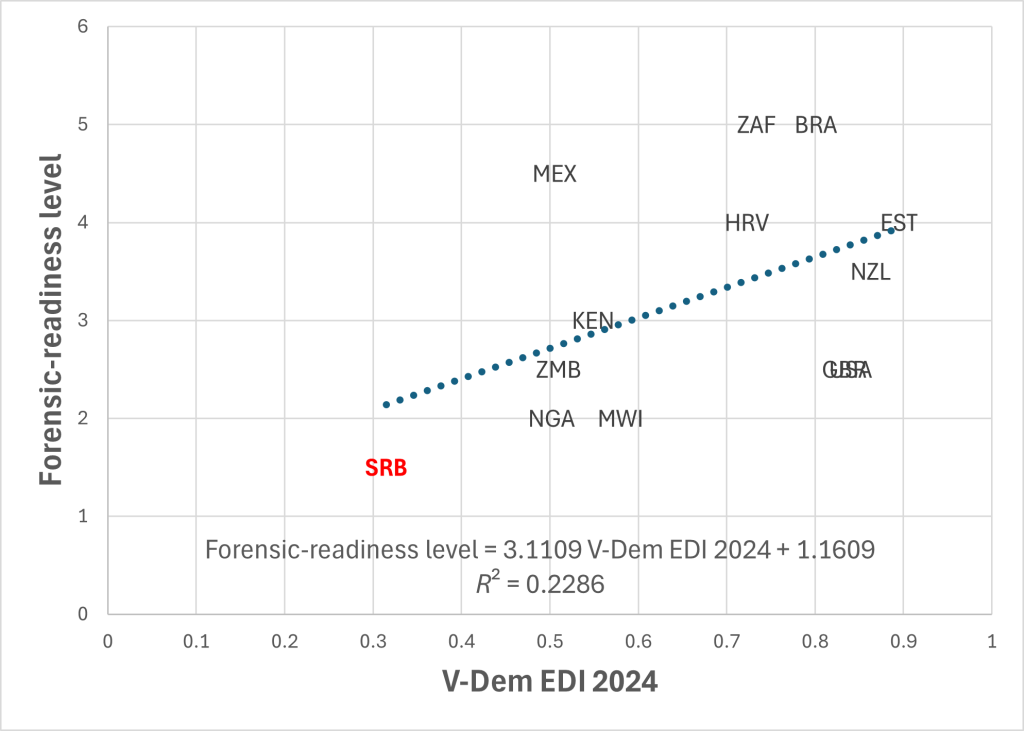
The strongest relationship in the sample is between forensic-readiness and V-Dem’s Electoral Democracy Index. The correlation is positive, around 0.48, and the regression explains about 23% of the variation in forensic-readiness. This is the clearest statistical pattern, but it remains exploratory. The sample is small, and the relationship is not statistically significant at the conventional 5% level.
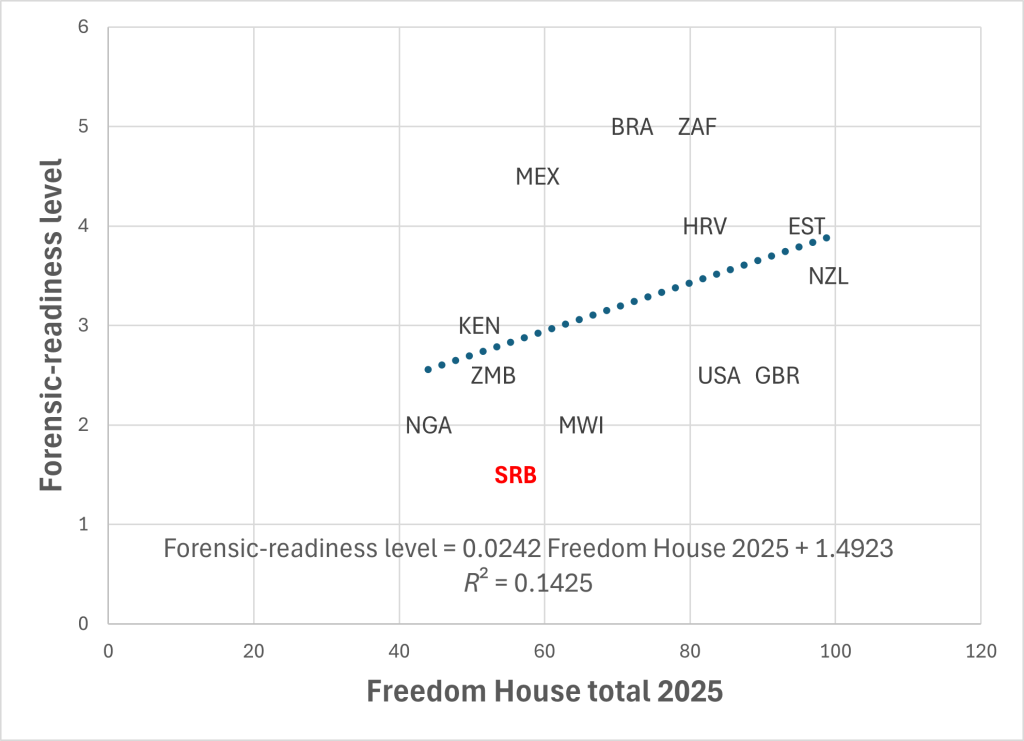
Freedom House total score also has a positive but weaker relationship with forensic-readiness, with a correlation of about 0.38 and R² around 0.14. This supports a cautious conclusion: freer countries are often better at publishing usable election data, but freedom alone does not determine forensic-readiness.
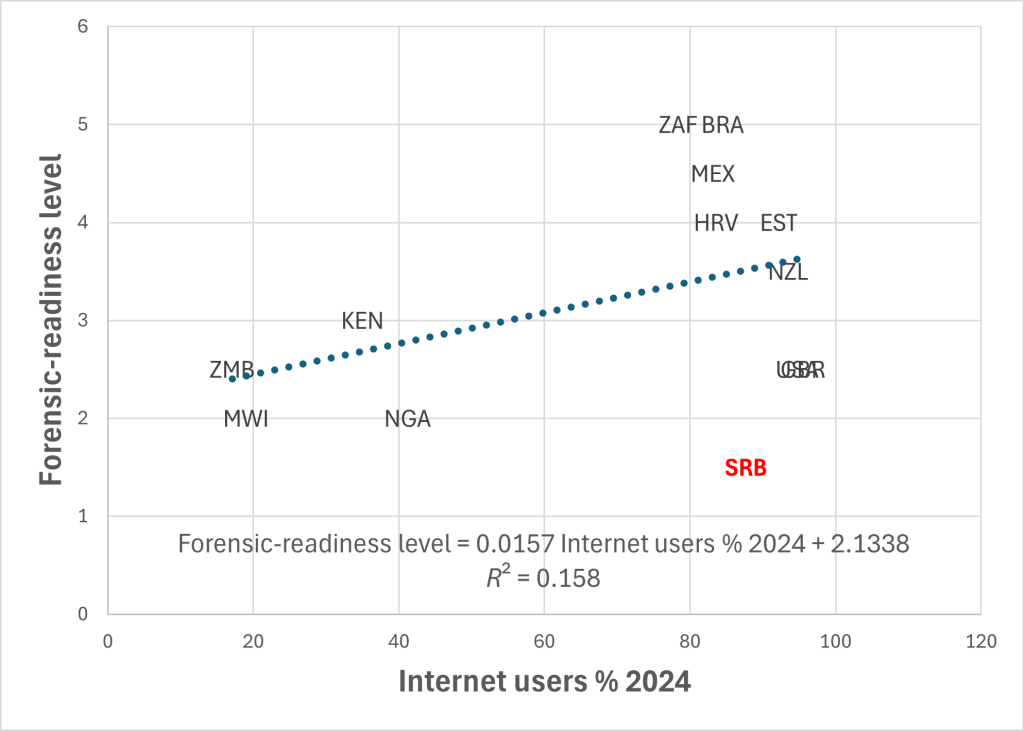
Internet penetration has a modest positive relationship, with correlation around 0.40 and R² around 0.16. This is particularly interesting because it shows that digital capacity is not enough. Serbia, the UK and the US have high internet penetration, but their forensic-readiness scores are lower than one might expect if technology alone were the explanation. The missing elements are legal obligation, institutional design, centralisation, open-data standards and political will.
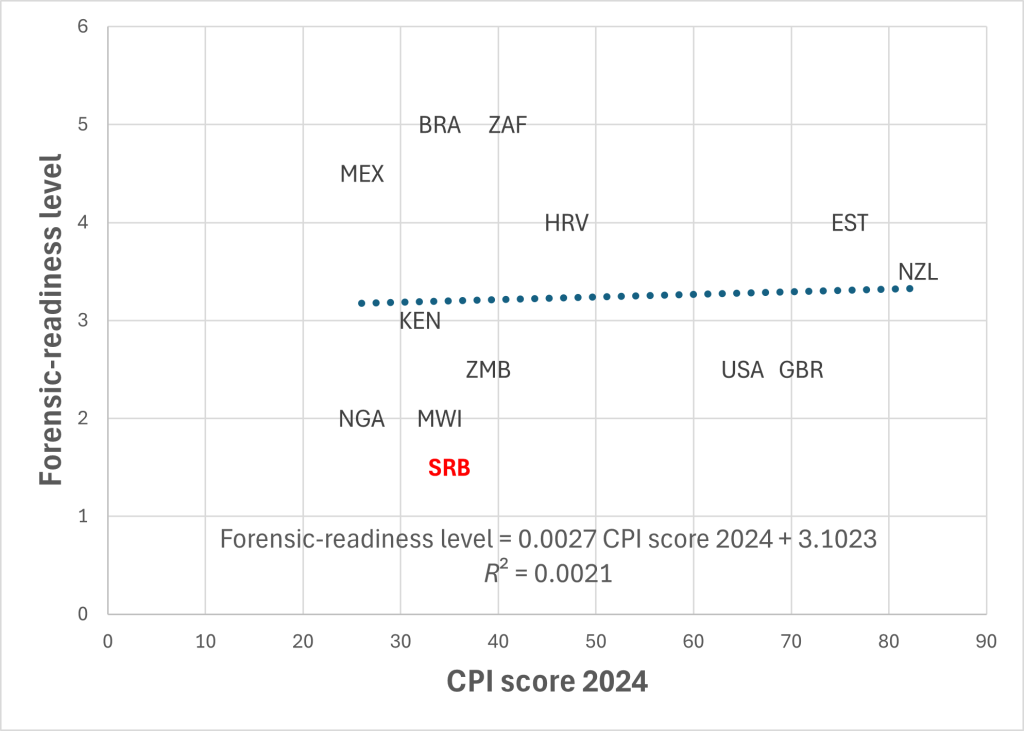
The CPI result is even more revealing. The correlation between forensic-readiness and CPI is almost zero. In this sample, lower perceived corruption does not automatically mean better election-data usability. Brazil, Mexico and South Africa have stronger forensic-readiness than several countries with better CPI scores. This undermines a simplistic “good governance explains everything” interpretation.
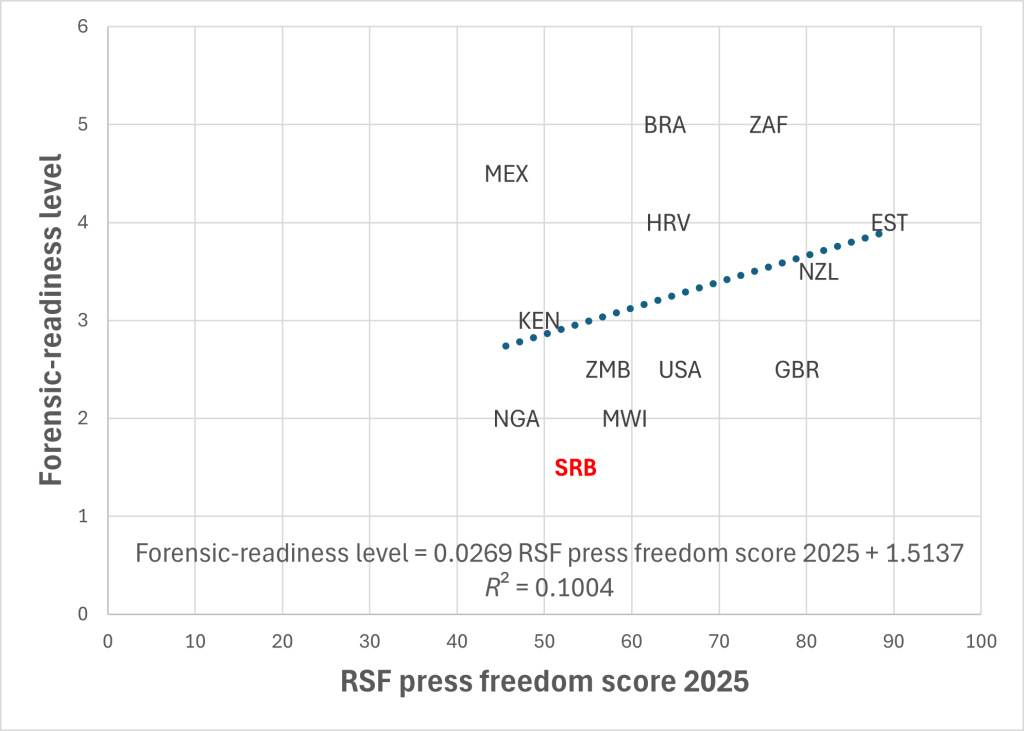
The RSF press freedom score is positively related to forensic-readiness, but weakly. Media freedom matters because journalists need access to data and space to report on anomalies. But media freedom alone cannot create a clean election dataset. Election commissions, laws and technical systems still matter.
The most important conclusion from the scatterplots is not the slope of any single regression line. The most important visual pattern in scatterplots is the presence of positive and negative deviants. Brazil and South Africa are positive examples: their election-data systems are stronger than one would predict from some broader governance indicators. The UK and US are negative cases only in a narrow technical sense: they are consolidated democracies but not centralised forensic-data models. Serbia is a different kind of negative case: its weaker score is more serious because it sits in a low-trust/hybrid context where forensic-ready data are needed precisely to build public confidence.
6. Lessons from Latin America and Africa
Brazil and Mexico show that election-data systems can be built as public infrastructure. Brazil’s ballot-box bulletin datasets are especially important because they connect the polling-place logic of election results with machine-readable public data. Mexico’s PREP system provides a database for preliminary electoral results, while INE’s SICEE system allows users to explore detailed election statistics including results by section and polling place.
South Africa shows that live public results are possible at national scale. Its Electoral Commission describes a dashboard where live election results are updated every 5–10 minutes after voting stations close, and its downloadable reports include voting-district-level reporting. For Serbia, this matters because it disproves a familiar excuse: that forensic-ready transparency is too complicated, too expensive or only possible in a handful of rich democracies.
African observer coalitions add a second lesson. In countries where official institutions are contested, NGOs can become part of the transparency infrastructure. Yiaga Africa’s PVT in Nigeria and CCMG’s PVT in Zambia show how observer coalitions can provide independent evidence streams. This does not replace official results, but it changes the incentives. If official and observer data diverge, the discrepancy becomes a public issue.
The broader lesson is clear: low-trust systems do not have to wait for trust to magically appear. They can build institutions, portals, observer networks and data systems that produce trust through repeated verification.
7. Serbia in comparative perspective
Serbia’s problem is not the complete absence of election information. The problem is the gap between formal visibility and forensic usability.
RIK’s results interface allows users to filter results by election type, region, municipality and polling station, and displays fields such as registered voters, turnout and processed polling stations. RIK also publishes polling-board protocols for the 2023 parliamentary elections. These are important elements of documentary transparency. They should not be dismissed.
But they are not enough.
A scanned protocol is evidence, not data infrastructure. A web interface is useful for browsing, but it is not necessarily useful for rapid forensic analysis. A delayed or poorly structured Excel file may be better than a PDF, but if it arrives after complaint deadlines or requires extensive cleaning, it cannot perform its democratic accountability function.
Serbia therefore needs to move from PDF transparency to forensic-ready transparency. That means publishing, immediately after polling stations close and as results are processed, clean polling-station-level datasets that include registered voters, voters who voted, ballots cast, valid votes, invalid ballots, votes by list, geographic identifiers, polling-station identifiers, timestamps and revision logs. Scanned protocols should still be published, but as supporting evidence, not as the primary data source.
The comparative evidence also shows why Serbia cannot hide behind examples from stable democracies. It is true that the UK and US are not Level 5 forensic-data systems. But they are consolidated democracies with long-established trust. Serbia is not in that position. In a hybrid or low-trust system, the transparency standard must be higher, not lower.
8. What government and official institutions should do
The first responsibility lies with official institutions. Serbia’s parliament, election administration, statistical authorities and relevant ministries should create a legal and technical framework for open election data.
The law should require publication of polling-station-level results in machine-readable format. It should define the minimum required variables: polling-station ID, municipality, district, registered voters, voters who voted, ballots cast, valid votes, invalid ballots, votes by list or candidate, and special categories such as diaspora or repeated voting where relevant.
The law should also define timing. Data should be published before complaint and appeal deadlines expire. A dataset published too late is not real accountability. It is historical documentation.
The format should be specified. CSV and clean XLSX should be the minimum standard. JSON/API access should be the modern standard. Scanned protocols should be mandatory as documentary evidence, but they should not be accepted as the only public form of polling-station-level data.
The election commission should maintain a permanent open election data portal. The portal should include metadata, codebooks, stable polling-station identifiers, historical files, timestamps, revision logs and clear documentation. If a number changes, the public should see what changed, when and why.
This is not an anti-government proposal. It protects the election administration as much as it protects voters. When data are open, clean and verifiable, false claims are easier to dismiss and real problems are harder to hide.
9. What NGOs and observer coalitions should do
NGOs should not wait passively for the state to modernise. Serbian observer coalitions, universities, journalists, civic-tech groups and professional associations can begin building the parallel infrastructure now.
They should develop mobile reporting applications for observers. These applications should collect structured data, not only narrative reports. Observers should be able to enter turnout, incidents, protocol figures and photographs of signed protocols.
They should conduct parallel vote tabulation where feasible. A statistically designed PVT can provide an independent check on official results. Even when a full PVT is not possible, structured observer data can still identify anomalies and inconsistencies quickly.
They should create independent public dashboards. These dashboards should not pretend to be official results, but they can show observer coverage, reported incidents, protocol availability, turnout patterns and discrepancies between official and observer-collected data.
They should publish open-source forensic tools. Serbia does not need to reinvent every method after every election. Standard scripts can be prepared in advance for turnout-vote-share analysis, invalid-ballot analysis, polling-station size stratification, historical comparison, Benford-style tests, cumulative diagrams and regression diagnostics.
They should also train observers differently. Observation should no longer be only narrative: “what happened at the polling station?” It should also be structured: “what numbers were recorded, in what form, at what time, and how can they be checked?”
Finally, NGOs should campaign for legal reform. The demand should be simple: election data are public data. They must be published immediately, at polling-station level, in machine-readable form, with scanned protocols as supporting evidence.
10. What international actors should support
International actors should also update their standards. OSCE/ODIHR, the EU, the Council of Europe, international NGOs and donors should treat machine-readable polling-station-level election data as a core electoral-integrity recommendation, not as a technical luxury.
Support should go not only to observation missions but also to civic-tech infrastructure: mobile observer apps, secure protocol storage, public dashboards, open-source forensic scripts, data training and rapid-response analytical teams.
The strongest recommendation for Serbia should be practical and measurable: before the next major election cycle, the country should have a legally guaranteed open election data portal with polling-station-level CSV/XLSX downloads, API access, scanned protocols, metadata, timestamps and revision logs.
11. Conclusion: from trust by declaration to trust by verification
The comparative evidence does not say that one model fits every country. It says something more important: election-data transparency has become a measurable democratic capacity.
Some countries have strong official systems. Some rely more heavily on observer coalitions. Some consolidated democracies remain decentralised and weaker on centralised polling-station-level data. Some low-trust countries have built modern systems precisely because they had to.
For Serbia, the lesson is direct. Publishing scanned protocols is not enough. Displaying results through a web interface is not enough. Delayed or messy files are not enough. A low-trust electoral system needs a higher standard: clean, timely, polling-station-level, machine-readable data that can be independently checked before legal deadlines expire.
Trust in elections is not built by asking citizens to trust. It is built by giving them the means to verify.
Internet resources
Brazil: https://dadosabertos.TSE.jus.br/dataset/resultados-2024-boletim-de-urna
Croatia: https://www.izbori.hr/site/en/general-information/open-data-1840/open-data/1851
Freedom House: https://freedomhouse.org/country/scores
Kenya – Carter Center: https://cartercentee50c07c05.blob.core.windows.net/blobcartercentee50c07c05/wp-content/uploads/2023/03/kenya-2022-elections-final-report.pdf
Malawi: https://mec.org.mw/election-results/
Mexico: https://prep2024.INE.mx/publicacion/nacional/base-datos
Nigeria: https://www.inecnigeria.org/election-results/
Serbia: https://www.rik.parlament.gov.rs/542645/rezultati/
Serbia: https://www.rik.parlament.gov.rs/zapisnici/sr/542486
South Africa: https://results.elections.org.za/
United Kingdom: https://commonslibrary.parliament.uk/research-briefings/cbp-10009/
USA: https://www.FEC.gov/introduction-campaign-finance/election-results-and-voting-information/
Zambia: https://ccmgzambia.org/parallel-vote-tabulation/
Quantitative indicator annex
The indicators in this annex come from different sources and different years, because each database is updated according to its own schedule. This is acceptable for exploratory comparative analysis, but we emphasize that this is not a strictly synchronized panel-base for formal causal inference. The appendix serves for an illustrative comparison: to see if countries with a higher degree of democracy, media freedom, internet penetration or a lower perception of corruption also have a higher level of forensic preparedness of election data.
Table 3. Quantitative indicators
| Country | ISO3 | Trust context | Forensic-readiness level | Freedom House status 2025 | Freedom House total 2025 | V-Dem RoW 2024 | V-Dem EDI 2024 | CPI 2024 score | GDP per capita, current US$, 2024 | Internet users %, 2024 | RSF press freedom score 2025 | RSF rank 2025 |
|---|---|---|---|---|---|---|---|---|---|---|---|---|
| Brazil | BRA | Democratic / strong official electoral-data infrastructure | 5 | Free | 72 | Electoral democracy | 0.801 | 34 | 10,311 | 84.5 | 63.8 | 63 |
| Mexico | MEX | Democratic / high-capacity but contested elections | 4–5 | Partly Free | 59 | Electoral democracy | 0.505 | 26 | 14,186 | 83.1 | 45.6 | 124 |
| South Africa | ZAF | Democratic / strong official transparency infrastructure | 5 | Free | 81 | Liberal democracy | 0.734 | 41 | 6,267 | 78.4 | 75.7 | 27 |
| Estonia | EST | Consolidated democracy / advanced digital state | 4 | Free | 96 | Liberal democracy | 0.895 | 76 | 31,428 | 92.2 | 89.5 | 2 |
| Croatia | HRV | Democratic / regional comparator | 4 | Free | 82 | Electoral democracy | 0.723 | 47 | 24,050 | 83.6 | 64.2 | 60 |
| New Zealand | NZL | Consolidated democracy / high institutional trust | 3–4 | Free | 99 | Liberal democracy | 0.863 | 83 | 49,205 | 93.5 | 81.4 | 16 |
| United Kingdom | GBR | Consolidated democracy / high trust, constituency-based reporting | 2–3 | Free | 92 | Electoral democracy | 0.833 | 71 | 53,246 | 95.5 | 78.9 | 20 |
| United States | USA | Consolidated democracy / highly decentralised administration | 2–3 | Free | 84 | Liberal democracy | 0.84 | 65 | 84,534 | 94.7 | 65.5 | 57 |
| Serbia | SRB | Hybrid / low-trust electoral context | 1–2 | Partly Free | 56 | Electoral autocracy | 0.315 | 35 | 13,679 | 87.7 | 53.6 | 96 |
| Kenya | KEN | Competitive / contested electoral environment | 3 | Partly Free | 51 | Electoral democracy | 0.549 | 32 | 2,132 | 35 | 49.4 | 117 |
| Nigeria | NGA | Hybrid / low-trust and highly contested environment | 2 | Partly Free | 44 | Electoral democracy | 0.502 | 26 | 1,084 | 41.2 | 46.8 | 122 |
| Zambia | ZMB | Competitive / trust-building electoral context | 2–3 | Partly Free | 53 | Electoral democracy | 0.51 | 39 | 1,187 | 17.1 | 57.3 | 82 |
| Malawi | MWI | Competitive / trust-building after annulled election context | 2 | Partly Free | 65 | Electoral democracy | 0.58 | 34 | 523 | 19 | 59.2 | 76 |
Source notes
Freedom House values are from Freedom in the World 2025, using total score and status; Freedom House explains that it assesses political rights and civil liberties across countries and territories.
V-Dem values use the Electoral Democracy Index and Regimes of the World classification. The annex currently uses the Data360/V-Dem Core data available through 2024; V-Dem version 16 was published in March 2026, but the Data360 extract I used for the annex contains country-year values through 2024. V-Dem’s RoW classification distinguishes closed autocracies, electoral autocracies, electoral democracies, and liberal democracies.
Transparency International’s CPI 2024 uses a 0–100 scale, where 0 indicates highly corrupt and 100 very clean; the 2024 index ranks 180 countries and territories.
World Bank GDP per capita and internet-use indicators are from World Development Indicators. GDP per capita is in current US dollars; internet use is the share of individuals using the internet.
Reporters Without Borders’ World Press Freedom Index 2025 ranks press freedom on a 0–100 score, with higher scores indicating better press-freedom conditions. The RSF/Data360 dataset provides country scores and ranks.

Director of Wellington based My Statistical Consultant Ltd company. Retired Associate Professor in Statistics.
Has a PhD in Statistics and over 45 years experience as a university professor, consultant, international researcher and government advisor.